America’s largest banks have competed for customers for decades. Yet when technology companies such as PayPal, Venmo and Cash App began to change how Americans send money and threatened their market share, the banks came together in an unusual fashion to create a unified payment network that moves their money.
In 2017, seven of the largest banks, including Bank of America, JPMorgan Chase and Wells Fargo, launched Zelle through a company they own together. It grew out of a shared payment service those three banks had started in 2011, which the others later joined. Zelle allows a customer of one bank to send money to a customer of another in minutes, usually for free. Zelle reports that more than US$1 trillion moved through it in 2024, across 3.6 billion payments, and that about 2,300 banks and credit unions offer it. Like every other payment system, it has also faced criticism over scams, a reminder that a shared network needs shared rules on fraud and refunds.
Why has Jamaica not done the same?
Since 2012, Jamaica has made 16 formal attempts at mobile money. Sunday’s chart showed 13, and readers helped us find three more. GraceKennedy reminded me of GK One, which combines remittances with everyday payments. GraceKennedy says it processes more than J$1.5 billion in remittances a month and that more than 80% of its customers come back to use the app. Others told me about solutions that are not even registered in the formal system. Counting those, we are past 20.
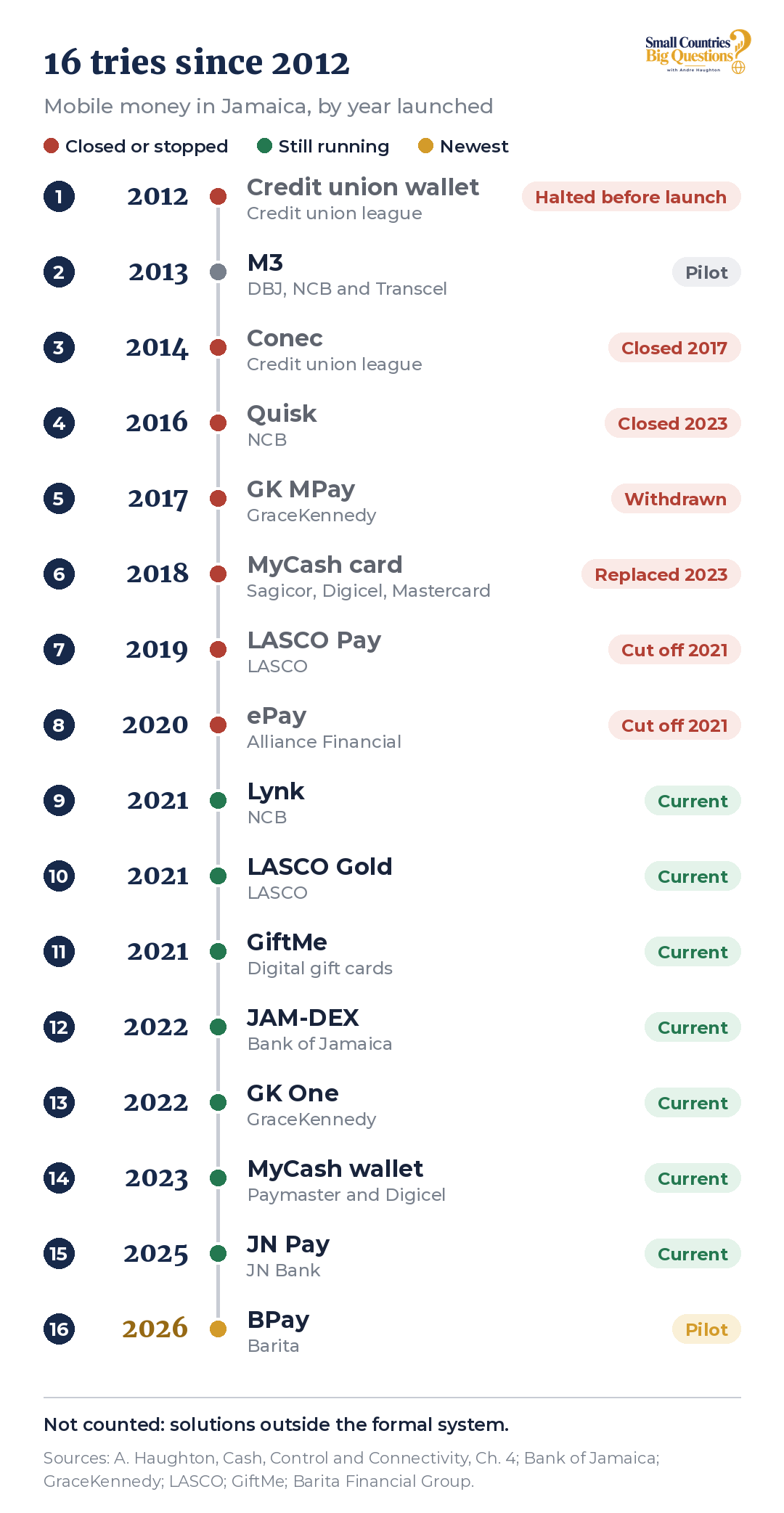
Seven have closed or stopped, seven are still running and two were pilots. MyCash appears twice, first as a card and then as a wallet. The list also includes GiftMe, a gift card platform that my students tell me works best for them, because they can use it at the supermarkets and food places they visit every day.
The problem is not that Jamaicans lack options. It is that the options cannot reach each other. At its peak, Quisk had about 400 merchants. Lynk has about 5,000. In 2023, the Bank of Jamaica found that 66.4% of micro businesses accepted no digital payment at all. And each time a wallet closed, Conec in 2017, LASCO Pay and ePay in 2021, Quisk in 2023, Jamaicans learned to wait and see. Cash has never been discontinued.
Where can you put money in and take it out?
Even where money can move between banks, a wallet is only as good as the places where you can load it and cash it out. If I have to go to one bank’s branch to put money on my wallet, or to its ABM to take money off, that wallet has fewer doors than the cash in my pocket. Every closed system cuts the number of access points.
So the key is to increase the access points. We have to find the ones closest to the grassroots, the places people already know and trust: the remittance agent, the bill payment counter, the supermarket, the pharmacy and the corner shop. Then we push those access points and coordinate them, so that any one of them can load or cash out any wallet.
How many times must Jamaica build the same road?
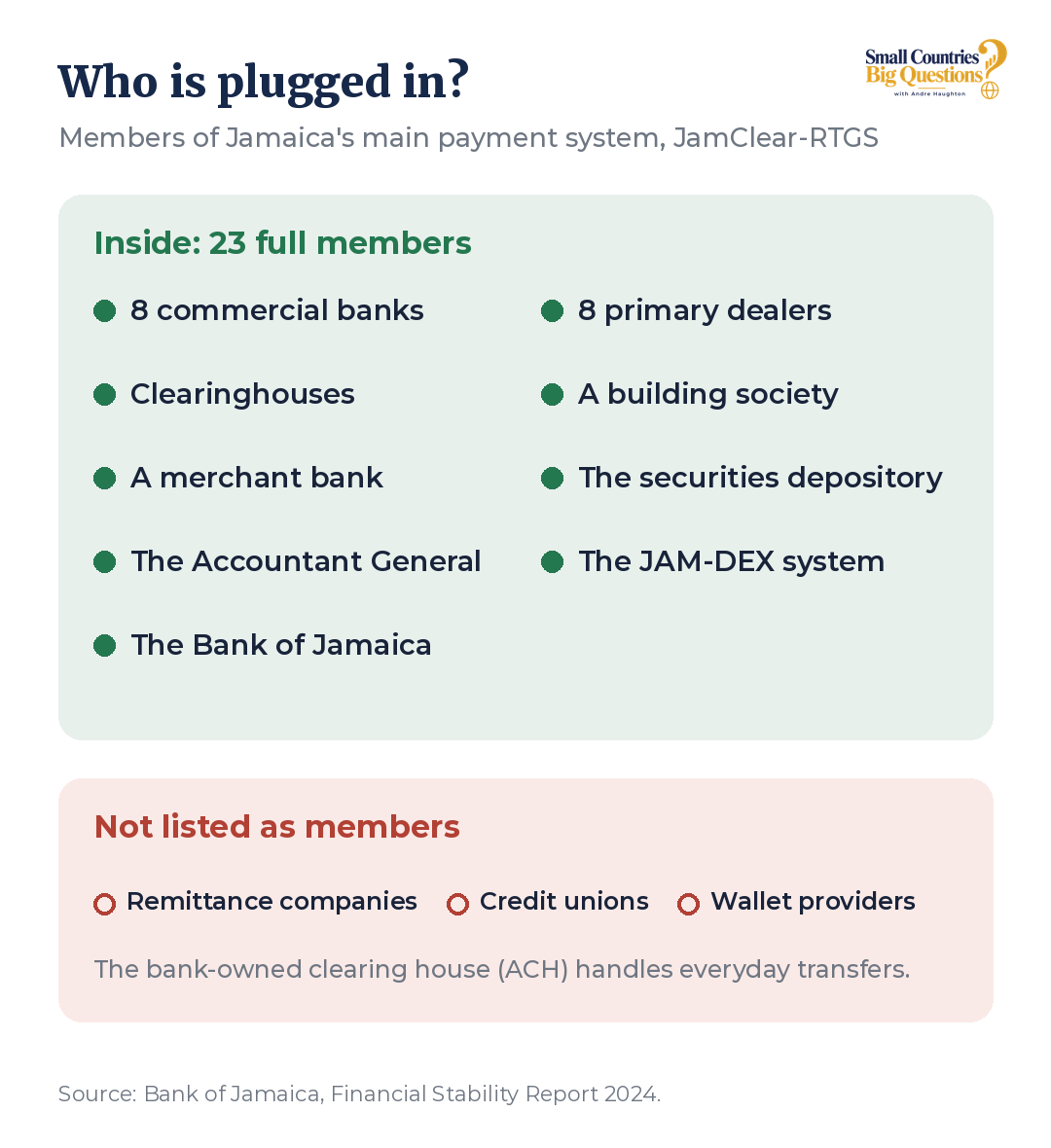
The pipes we already have tell the same story. The Bank of Jamaica’s system for large payments, JamClear-RTGS, has 23 full members, mostly banks and securities dealers. The Automated Clearing House, which handled 16.5 million transactions worth J$1.47 trillion in 2024, is owned by the commercial banks. Remittance companies, credit unions and wallet providers are not among the listed members. Jamaica does not need another wallet. It needs the system we already have to let every provider in.
Must the government build it, or should the banks?
This is where the international experiences become especially interesting.
America’s Zelle is principally a bank-owned network. Brazil’s Pix is operated by the central bank. India’s Unified Payments Interface, or UPI, is coordinated through the National Payments Corporation of India, an institution established by the banking industry with the support of the country’s monetary authorities. Three different approaches. One important principle. Compete in providing financial services, but cooperate on the infrastructure that connects them.
Jamaica does not have to copy any one of these models exactly. We must design a model that reflects the structure of our financial sector, the size of our economy and the needs of our people.
In my view, the Bank of Jamaica should bring the institutions together and establish a clear framework for interoperability. The banks, credit unions, remittance companies and licensed payment service providers should participate in developing and financing the network. Telecommunications companies would also have an important role, particularly in ensuring reliable connectivity and access for people outside the major urban centers.
But there is an economic problem that must be addressed. A bank that spends money on an app, on security and on signing up shops has little reason to let its competitors use what it built. For each bank, keeping customers inside its own app makes sense. For Jamaica, it does not. A payment app is only as useful as the number of people and shops it can reach. What is rational for one institution is inefficient for the country. Yet you do not have to own the entire road to make money from the vehicles traveling on it.
What did the hurricanes expose?
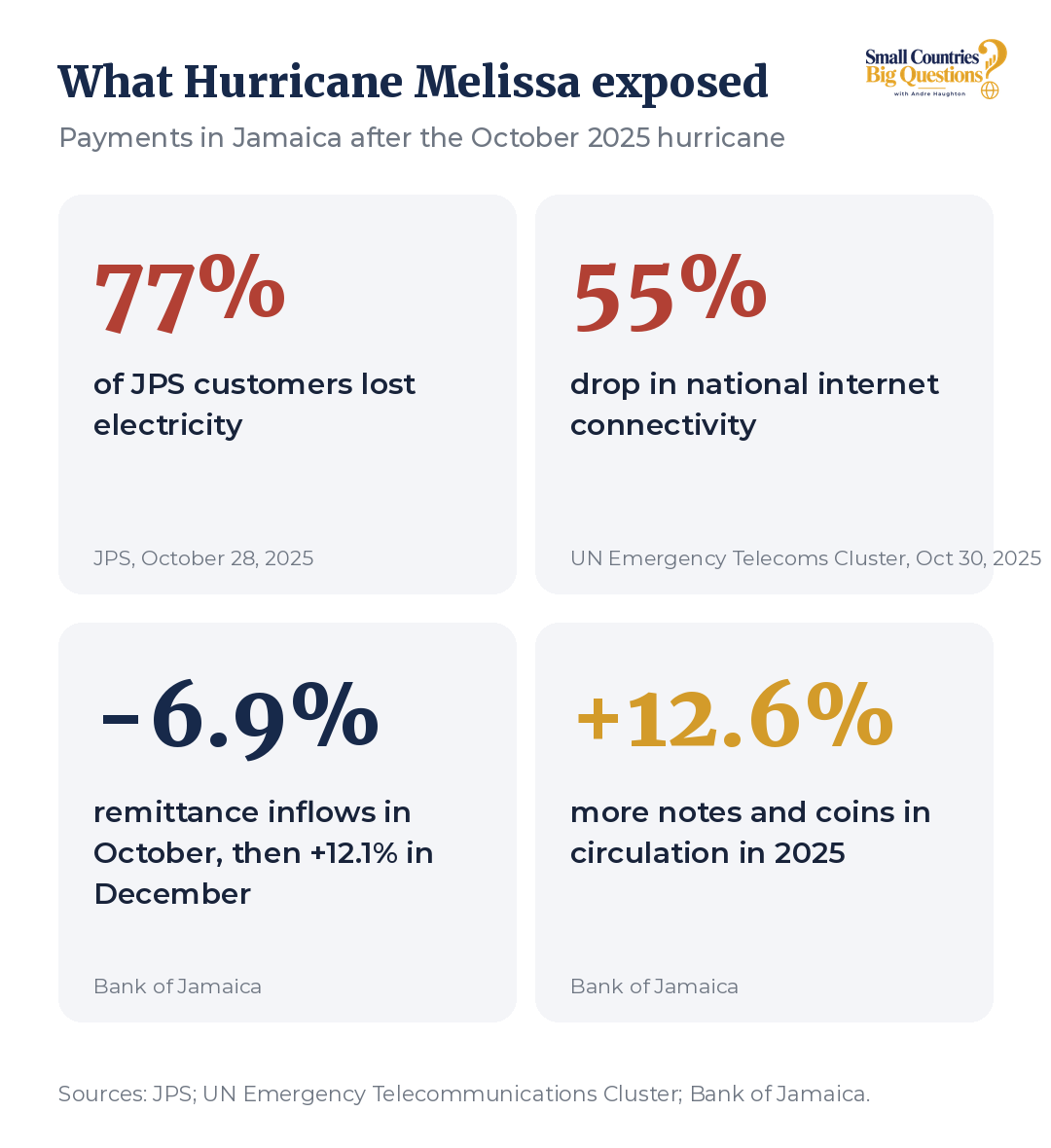
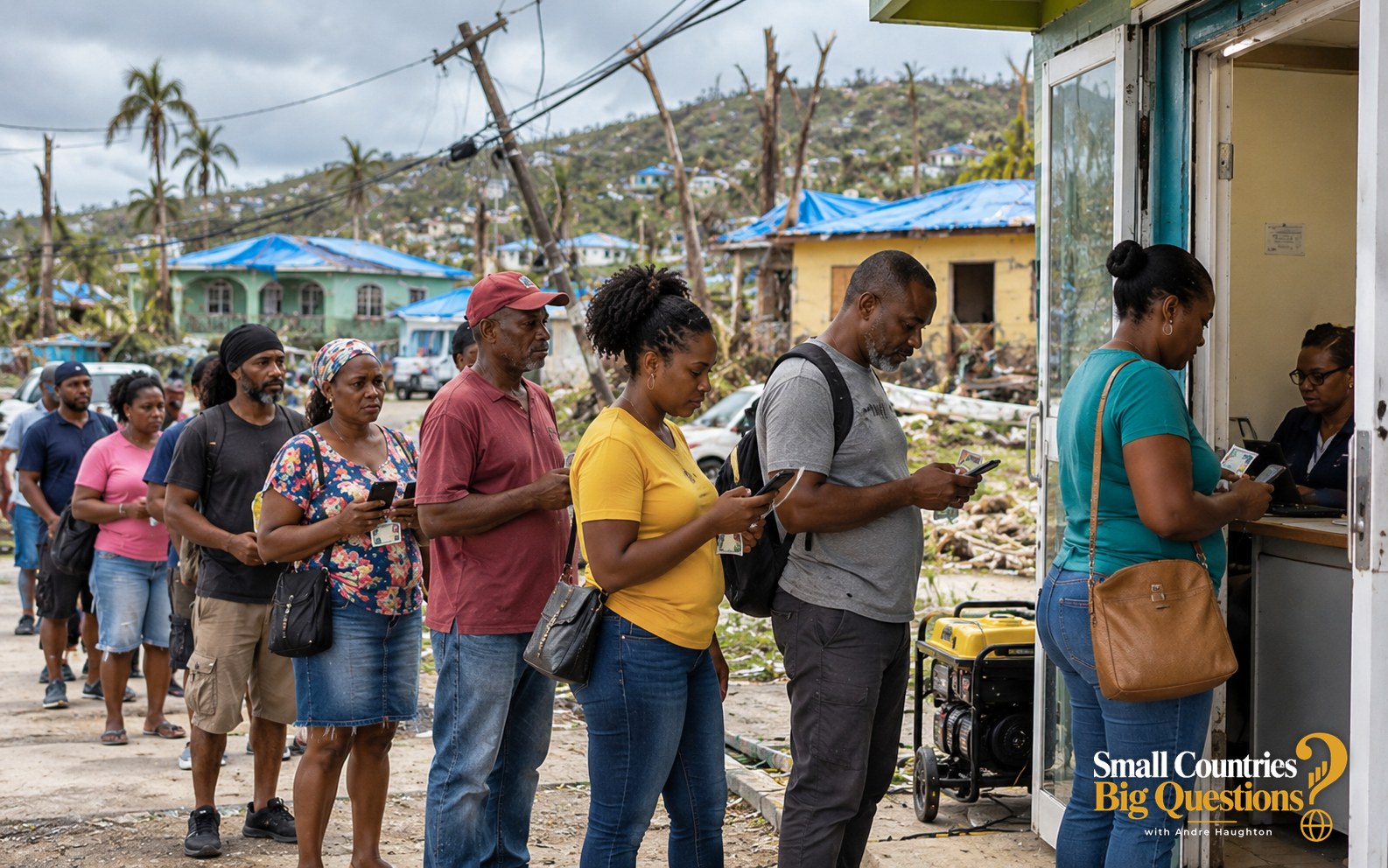
Back-to-back hurricanes, Beryl in 2024 and Melissa in October 2025, exposed how vulnerable our payment system is. After Melissa, 77% of JPS customers lost electricity, and national internet connectivity fell by more than half. In the hardest-hit parishes, cash became the only practical way to pay. Notes and coins in circulation rose 12.6% in 2025 as people held more cash for safety. Remittance inflows fell 6.9% in October, then rose 12.1% in December once families abroad could get money through.
Money did reach the country. The World Bank’s catastrophe bond paid US$150 million and CCRIF paid US$70.8 million. The hard part was getting money to people. When the World Food Programme set out to give cash grants to 16,000 households, it paid them through a remittance agent network.
A payment system is national infrastructure. Before a hurricane, people need more than one way to get money. During the outage, the system needs cash, backup power and satellite links. After it, relief should land quickly in any wallet or account.
What about money that crosses borders?
Cash works at home, but it cannot travel. In 2025, Jamaica received US$3.49 billion in remittances, according to the Bank of Jamaica, and between April and December, 89% came through remittance companies.
Our neighbors are building the regional road. In 2025, the central banks of Barbados and The Bahamas sent real payments between their two countries, instantly and in their own currencies, through the CARICOM Payment and Settlement System, CAPSS. The pilot now includes The Bahamas, Barbados, Trinidad and Tobago and the Eastern Caribbean. Jamaica is not among the first countries in it.
What should we do?
Here is where I would start.
First, open the core system to every regulated provider, so that money sent from GK One reaches Lynk, JN Pay, a credit union or a bank account instantly, using only a phone number.
Second, open every trusted counter as an access point, so that any remittance agent, bill payment counter or shop can load or cash out any wallet.
Third, agree common rules: who can join, what it costs, how fraud and refunds are handled, and what happens to customers’ money if a provider closes.
Fourth, build it for hurricanes, with backup power and connectivity, and a way to pay relief straight into any account.
Fifth, connect it to the world. Join CAPSS for the region, and link the remittance companies so that money from the diaspora lands in any Jamaican wallet.
Then measure what matters: whether every account can pay every other, how often payments fail, what they cost and whether the system stays up after a hurricane.
Who should call everyone to the table? Tell me in the comments.
Andre Haughton is a Professor of Economics at the University of the West Indies (UWI), Mona, specializing in international finance, global political economy, the structural challenges facing developing economies, and development in small states. He is the author of Overcoming Productivity Challenges in Small Countries: Lessons from Jamaica and Developing Sustainable Balance of Payments in Small Countries: Lessons from Jamaica. He has been recognized as the University of the West Indies’ Most Outstanding Researcher (2017) and for the Most Outstanding Research Project (2024), was named UWI Alumnus of the Decade (1999–2009), and is an IMF Distinguished Academic Fellow. Beyond academia, he is engaged in entrepreneurship, youth development initiatives, and strategic economic thinking aimed at advancing Jamaica’s development trajectory.
Unless we are able to build a cost effective infrastructure that enables a sustainable digital wallet in Jamaica during a national disaster such as Melissa, cash will always be the mode of choise for business transaction in Jamaica. Most Jamaicans cannot afford to maintain balance between have sufficient funds in a digital wallet and cash to flow during a hurricane or any other natural disaster crisis.
Floyd, that is an important constraint. A household with very little money cannot simply keep a second balance aside as a backup. Cash access, reliable networks and workable arrangements during outages all belong in this discussion. During the disruptions you experienced, was the greatest difficulty withdrawing cash or finding somewhere that could accept a payment?
To be honest, at this point , even after reading this article I am a bit indecisive as to who should call everyone to the table. As this article highlights the many intricacies that lies within the Jamaican economy and it’s finacial sector. But with my believed limited knowledge I will go with the bank of Jamaica should be the ones to call everyone to the table but in a unified way, to develops a system that benefits all.
Keshane, whoever convenes the process needs banks, wallet providers, merchants and customers at the table, with clear responsibilities and deadlines. The test should be whether ordinary transactions become easier and cheaper. Which result would matter most to you: transfers between wallets, lower charges or wider acceptance in shops?
What an excellent article Prof!. Thank you and you will appreciate my then question of which is best, because I faced the GK1 and JMMB snags.
While I believe ALL BANKS (Jamaica Bankers Association) should come together to create and own it, the operations management should fall under the BOJ as the single entity accepting other banking institutions payment fees.
Sharon, the snags matter more than the brand name when deciding what works for you. I would compare where the wallet is accepted, its charges, access to cash and how complaints are resolved. Coordination is worth discussing, but operating a service and regulating it are different responsibilities. What difficulty have you experienced with the wallets you tried?
All banks associated with multilink should come to the table and look at what wallet solution is currently within the public domain that has the most traction and back it with there existing network they will be able to push the use of a bank owned wallet that all banks connected via multilink can accept without an issue, therefore reducing the buy-in necessary. Then all banks will come together to target merchants to drive acceptance which will translate to more usage.
Cecilia, a shared network could make each wallet more useful by allowing customers and merchants to transact across providers. The arrangements should preserve competition and make charges clear. For a small merchant, what do you think is the bigger obstacle: getting set up, transaction costs or getting the money into the bank?
I am a returning resident who still relies on my bank and payment systems overseas because of their efficiency and security. I don’t really trust the platforms here. I am a customer with JN bank and I only learned about JN Pay from you. I had an issue with wiring funds last year, something I do monthly, an issue arose and JN refused to help. It took someone who someone before I got help. Improve the system and I am in.
Myrte, your experience shows why trust has to be earned through reliable service and proper resolution when something goes wrong. Advertising a wallet is not enough if customers struggle to get help with a transaction. Which would make the greatest difference for you: easier payments, clearer charges or faster resolution of problems? Please keep any account details out of the comments.