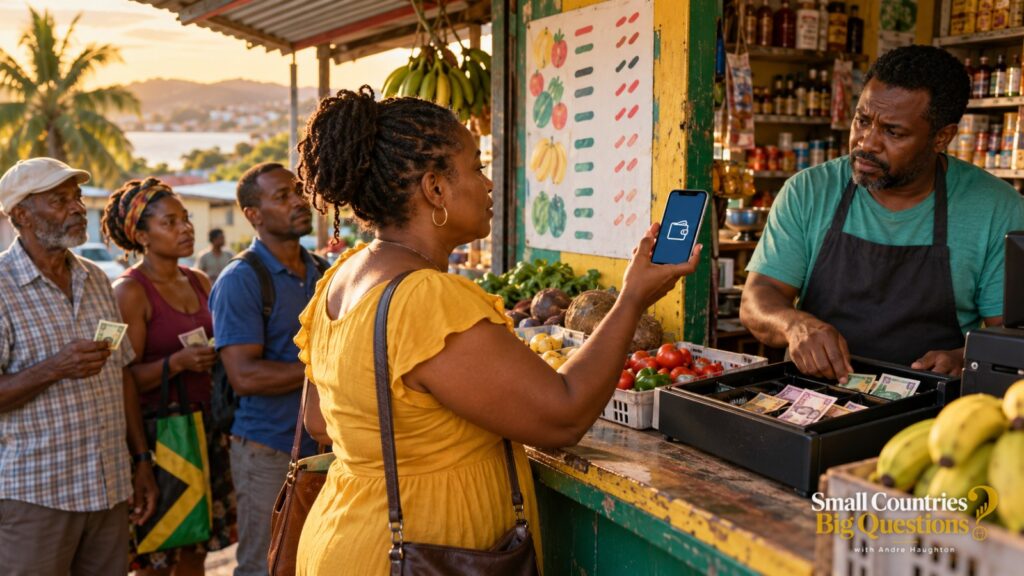
It is easy to get Jamaicans to sign up for mobile money. It is, however, difficult to get them to keep using it. Barita is the latest to try. Its digital wallet, BPay, is being tested with a small group of students on our campuses, teachers, police officers and community groups, and a wider rollout is promised in the coming weeks.
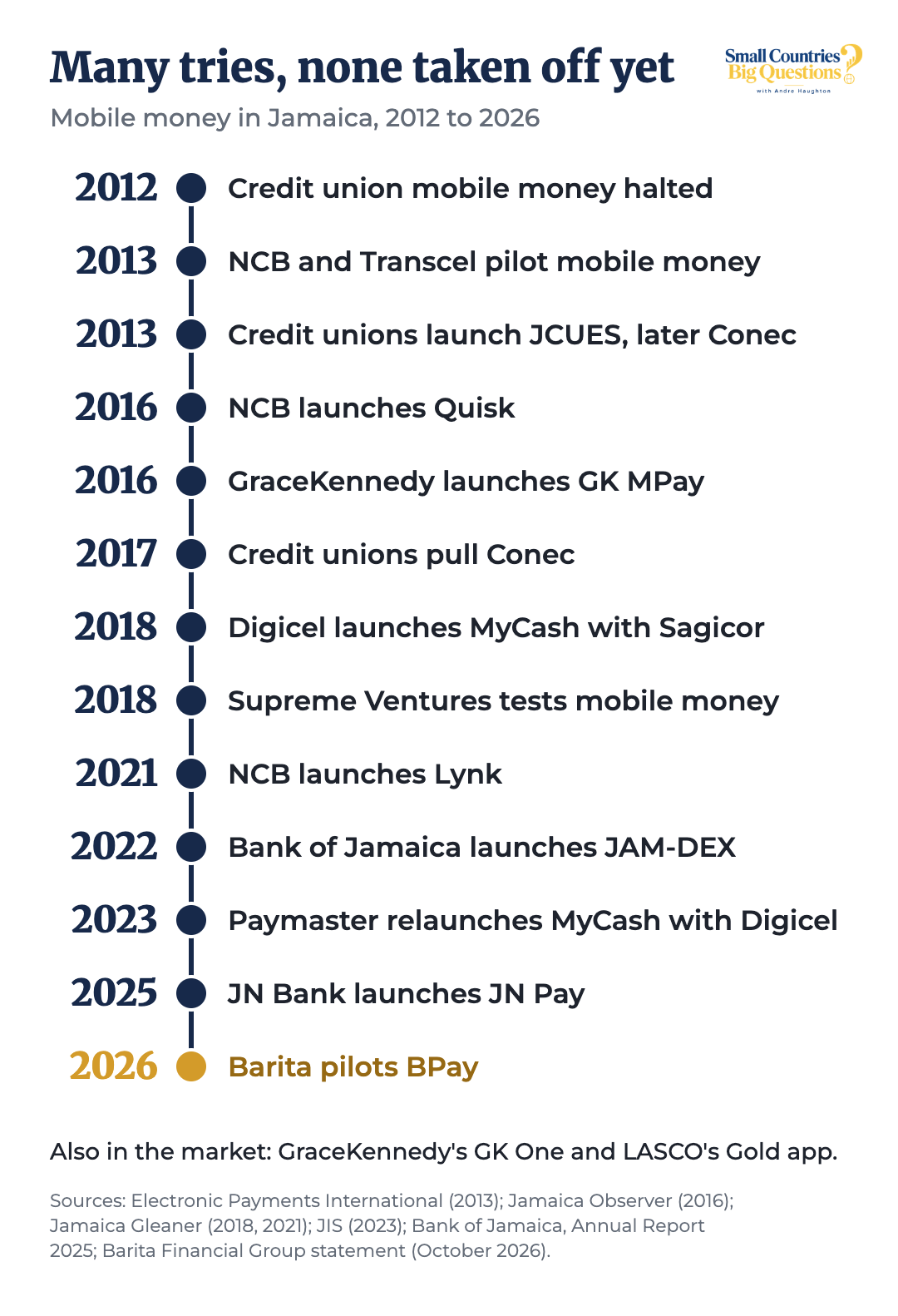
Jamaica has been here before. In 2012, the credit union league’s mobile money service was halted a day before launch. The credit unions came back in 2013 with JCUES, later renamed Conec, and pulled it in 2017 because too few people used it. Before Conec closed, NCB’s Quisk and GraceKennedy’s GK MPay arrived in 2016. Digicel’s MyCash followed in 2018, NCB’s Lynk in 2021, the Bank of Jamaica’s JAM-DEX in 2022, a relaunched MyCash in 2023 and JN Pay in 2025.
More than one in five adults still has no bank account, the Bank of Jamaica reported in 2023. Having an account is only the start. Jevon Henry, an assistant lecturer in our Department of Economics, found in his doctoral research that some households hold several bank accounts yet hardly use them. By definition, they are financially included. In reality, they are not.
The same situation exists with mobile wallets. At the end of 2025, 305,026 Jamaicans had registered a JAM-DEX wallet, yet on average each held less than J$500, J$473 to be exact. That is far short of what a household spends in a day or a week, a sign that the wallet is not yet taken seriously.
At UWI we have started researching why. At our Cash is King forum at UWI Mona on Thursday, October 15, 2026, I presented alongside Henry and two Bank of Jamaica research analysts, Etel Williams and Yohann Townsend. In my article last week, Cash is still king in Jamaica, we discussed trust. Here, I turn to what my fellow presenters found.
How do Jamaican households manage money?
For his study, Henry asked 34 Kingston households to record all money coming in and going out for twelve weeks in 2025, close to 4,000 transactions. These are Kingston households only, so they do not speak for the whole country. 40% of payments were under J$1,000. Food and transport accounted for 61% of payments but only 22% of the money spent.
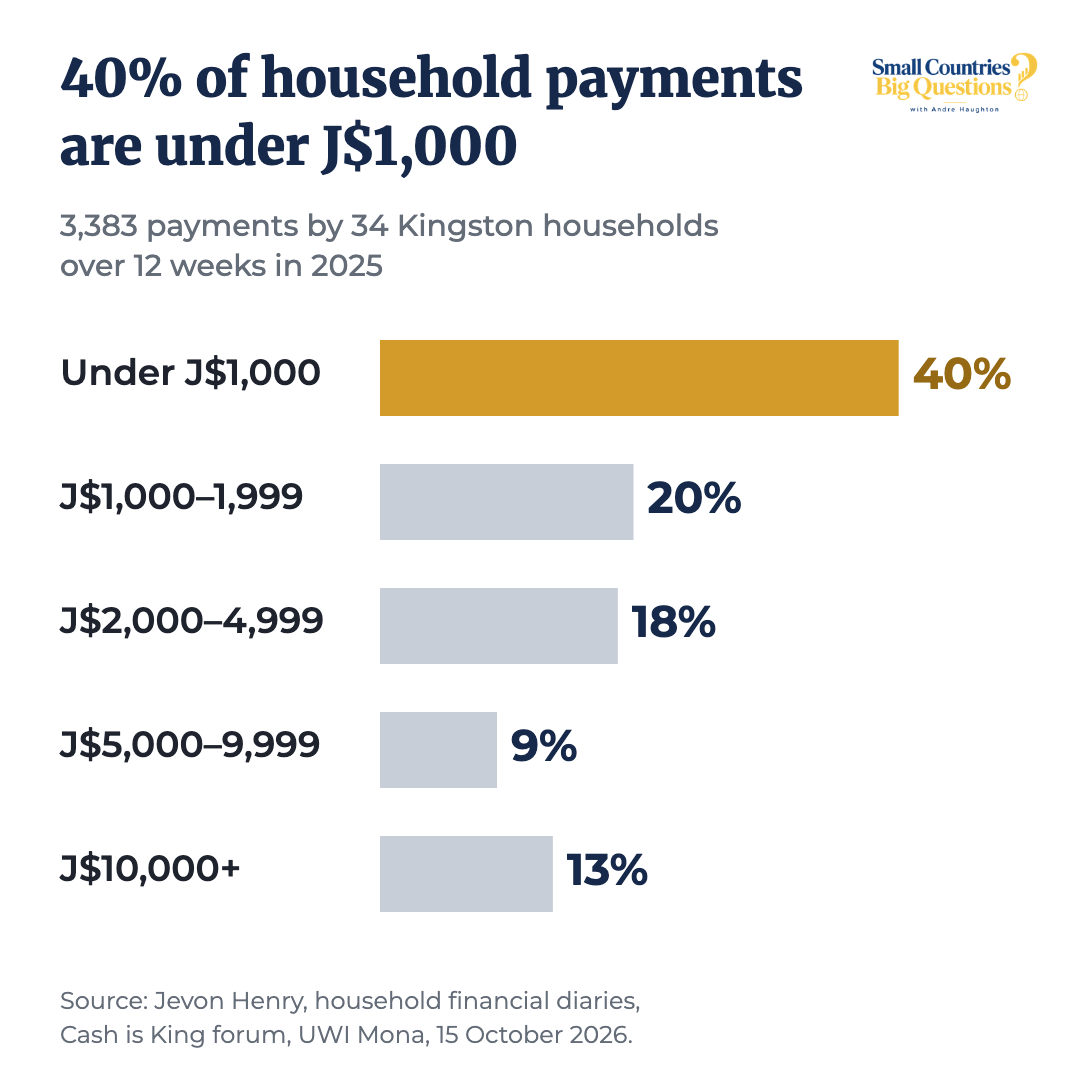
Banks are set up for larger sums. Participants described ABMs that would not give out bus fare, and one man chose where to keep his money because it allowed withdrawals as small as J$10. For anyone paid by the day, a trip to the branch can cost the day’s earnings.
Is paperwork the barrier?
Many believe people stay away from banks because of paperwork, such as proof of address. Henry checked this using a CaPRI survey of 607 adults across all 14 parishes. At first glance, people with proof of address were more likely to have a bank account. But those people also tended to have savings, more schooling and a steady income. When he compared people who were alike in those ways, proof of address made little difference. Savings, schooling and a steady income were what really counted. Easing paperwork alone will not bring people into the banks. Few even knew that banks offer basic accounts that need no proof of address: almost no one in the diaries had heard of them.
Why does partner still work?
“I view the partner and round robin like a bill,” one participant said. Partner forces people to save, and they are willing to pay for that. In a twelve-week partner, giving the banker a week’s contribution costs each member about 8% of what they put in, often paid by those who call bank fees unfair.
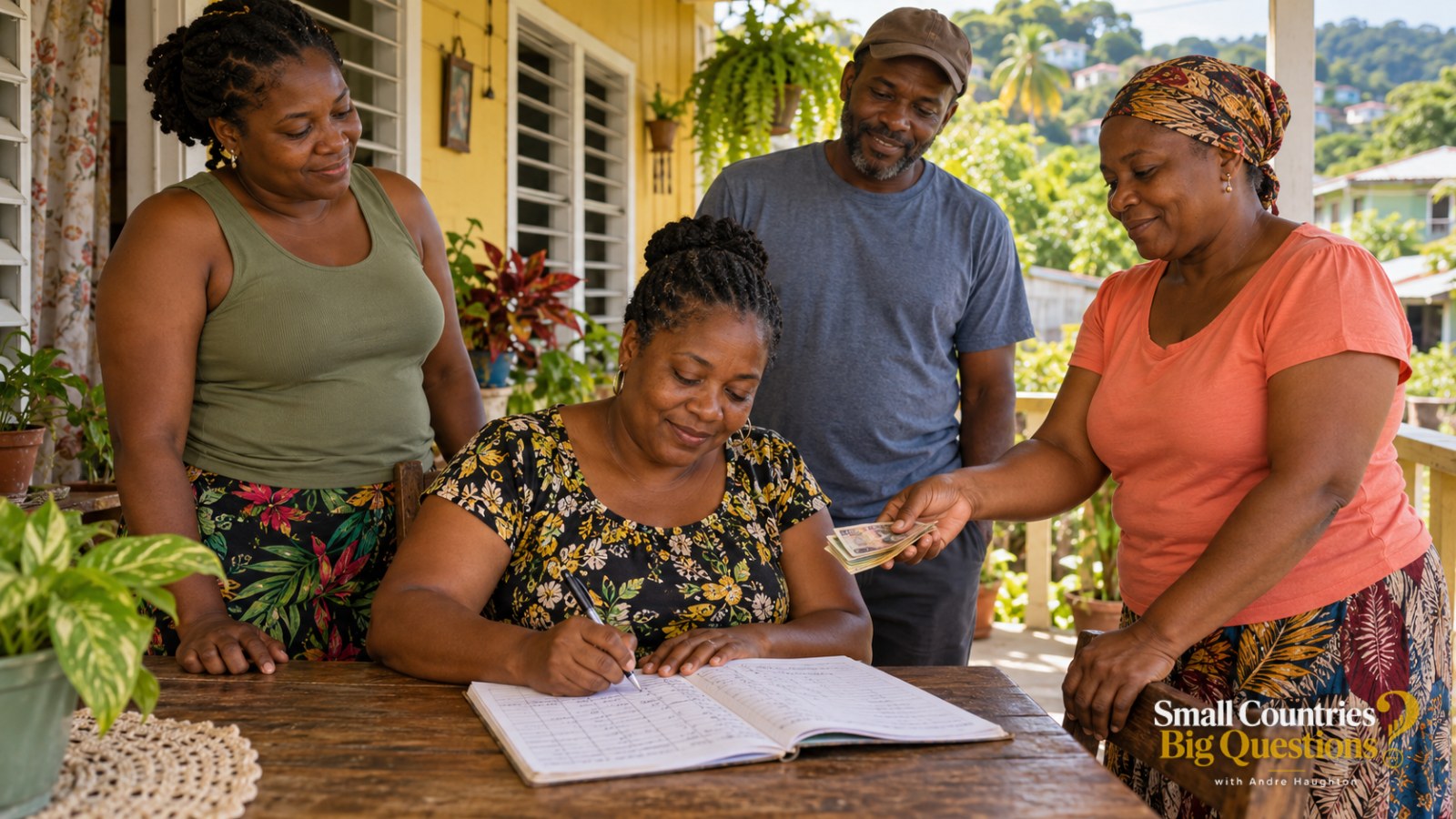
Many participants distrust banks because of what they have been through. Their biggest worry was whether they could get their money back if something went wrong. One family waited years on a fraud case and never recovered the money.
What did the bonus buy?
Sign-ups. “I think I’ve signed up for Jamdex, but I didn’t use it. I think I did for the bonus,” a participant recalled. Others had nowhere to spend it, thought it belonged to one bank, or already carried a card that did the job. Henry closed with a warning: “A subsidy can purchase enrolment, but it cannot make an unfavourable product favourable.” In other words, a bonus can get people to sign up, but it cannot make them use a product that does not suit them.
What does the Bank of Jamaica see?
Williams and Townsend described a problem central banks face everywhere. Merchants wait for customers, and customers wait for merchants. Most people who pay electronically already use a debit card, and cash seems free, but carrying it, counting it and losing it all cost money that people do not see.
“Technology launches systems. Culture launches behaviour.”
Etel Williams and Yohann Townsend, Bank of Jamaica, at the Cash is King forum
Some pieces are in place. JAM-DEX is legal money, just like notes and coins, and can pay property tax, vehicle fitness fees and traffic tickets online through Tax Administration Jamaica. What it still needs, the presenters argued, is to become “a fi wi sinting.”
What would make a provider invest?
A business case. The banks and companies that run wallets must spend money to connect their systems, are not sure enough people will use them, and have no clear way to make money from them. Merchants must fit terminals and train staff for customers who rarely ask to pay that way. Lynk carried JAM-DEX alone until JN Pay joined in May 2025, and the BOJ team said JAM-DEX needs many providers, not one or two.
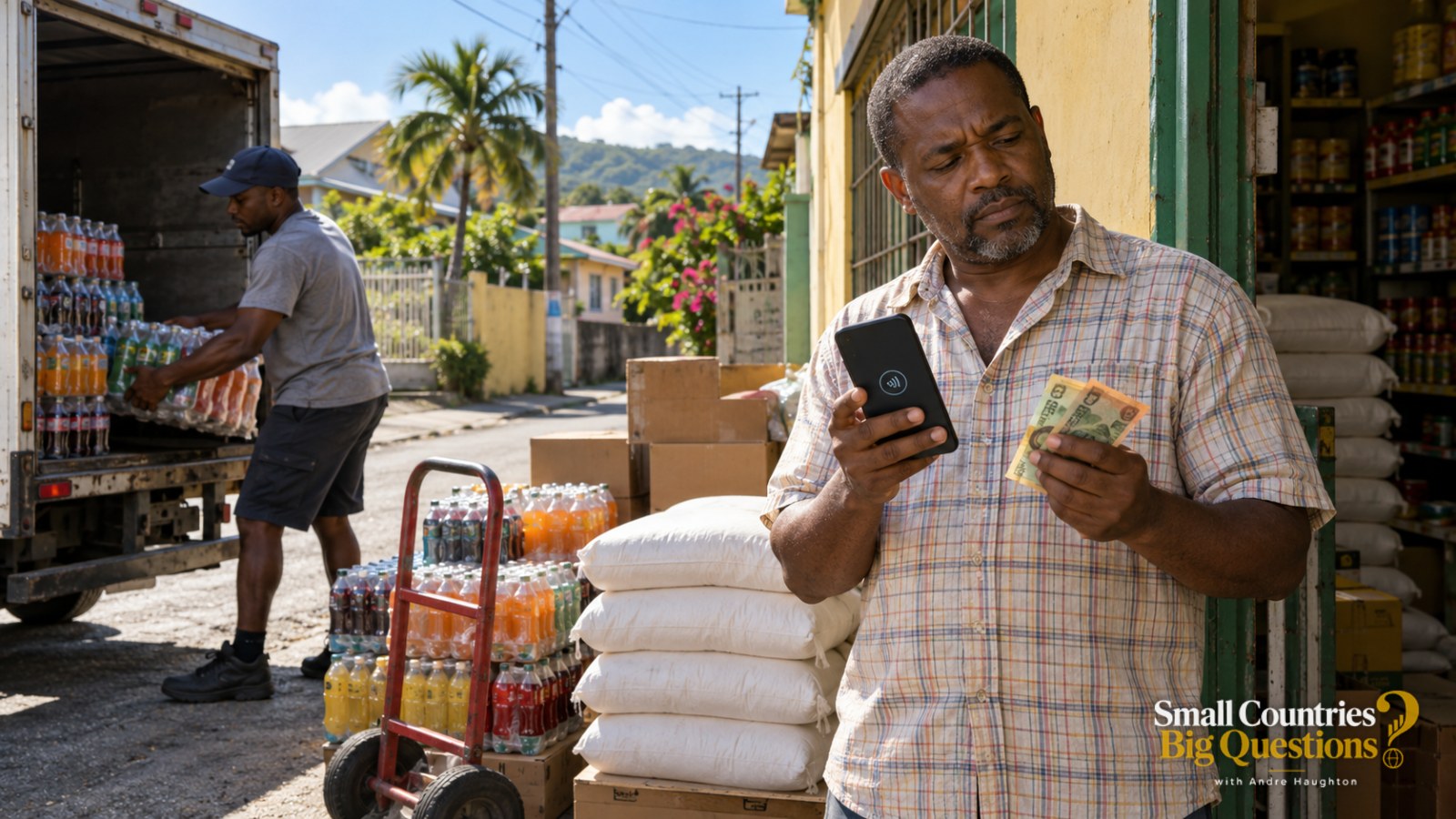
There is a further test, in my view. A shopkeeper paid in JAM-DEX must still settle with the wholesaler and the delivery man. If he has to move that money to his bank or turn it into cash before he can pay them, taking JAM-DEX only adds work.
What should we fix first?
First, digital money has to work for small sums. A small payment should be as easy by phone as by cash, and cash-out should come in the amounts people need.
Second, add a savings feature to the wallet that works like partner, putting aside a set amount each week toward a goal.
Third, get employers, shops and their suppliers using the same wallets, and make it worth the providers’ while. Paying wages and government benefits into wallets, for those who choose it, would get the money moving.
Fourth, judge a wallet by how often people use it each week.
The test for BPay, and every wallet after it, is whether a household can use it for the day’s purchases and the shopkeeper can use that money to pay the supplier.
Have you used a digital wallet and stopped? Tell me why in the comments.
Andre Haughton is a Professor of Economics at the University of the West Indies (UWI), Mona, specializing in international finance, global political economy, the structural challenges facing developing economies, and development in small states. He is the author of Overcoming Productivity Challenges in Small Countries: Lessons from Jamaica and Developing Sustainable Balance of Payments in Small Countries: Lessons from Jamaica. He has been recognized as the University of the West Indies’ Most Outstanding Researcher (2017) and for the Most Outstanding Research Project (2024), was named UWI Alumnus of the Decade (1999–2009), and is an IMF Distinguished Academic Fellow. Beyond academia, he is engaged in entrepreneurship, youth development initiatives, and strategic economic thinking aimed at advancing Jamaica’s development trajectory.
I firmly believe that the failure of digital wallets and mobile money services can largely be attributed to the distinction between two closely related yet fundamentally different concepts: usage and utilisation.
Usage refers to the simple act of employing something for its intended purpose, while utilisation goes a step further, emphasising the practical, effective, and optimal use of a resource.
The challenge, therefore, is not merely getting people to use these platforms but creating an ecosystem that encourages their widespread and meaningful utilisation.
To achieve this, the key players in the informal economy must be brought on board. If these digital wallets are being marketed primarily to the unbanked and underbanked, then public passenger vehicle (PPV) operators, bars, corner shops, street vendors, and other small businesses must be central to their adoption strategies.
After all, these are the spaces where a significant proportion of the unbanked and underbanked conduct their everyday transactions.
Ultimately, the success of mobile money will not be determined simply by how many people have access to a digital wallet, but by how seamlessly that wallet can be integrated into their everyday economic activities.
Thank you, Adam. Usage versus utilisation is a useful way to put it. Downloading the app is usage. Paying the taxi, the bar and the corner shop with it every day is utilisation. That only happens when those small businesses are on board, and when every wallet can pay every other wallet. That is the case I make in today’s article, Collaborate or fail?
Another key issue when these apps/wallets first launched was the promise of zero-rating. In my experience, none of them actually work without an active internet connection. While having continuous mobile data is becoming a norm today—which helps build daily usage habits through platforms like Lynk or BPay—that wasn’t the case early and even now as every Jamaican with a smart phone does not always have constant and reliable data connection.
Furthermore, this raises a crucial question: how will institutions ensure transactions remain secure and fraud-free in an offline environment? While we still have a long way to go, limited internet access has clearly been one of the biggest roadblocks to widespread adoption in my opinion.
You make an important distinction. Zero-rating means that eligible data use is not charged; it does not mean an app works without a network connection. Offline payments raise separate questions about transaction limits, verification and fraud controls. Providers need to explain those differences clearly. In your experience, was the obstacle a lack of data credit despite having a signal, or a lack of network coverage altogether?
Another key issue when these apps/wallets first launched was the promise of zero-rating. In my experience, none of them actually work without an active internet connection. While having continuous mobile data is becoming a norm today (albeit still not the case for many Jamaicans)—which helps build daily usage habits through platforms like Lynk or BPay—that wasn’t the case early on.
Furthermore, this raises a crucial question: how will institutions ensure transactions remain secure and fraud-free in an offline environment? While we still have a long way to go, limited internet access has clearly been one of the biggest roadblocks to widespread adoption.
Thank you, Alex. You are right. Many Jamaicans have a smartphone but not constant data, and a wallet that fails without data fails at the counter. Hurricane Melissa showed it again when internet connectivity dropped by more than half. Secure offline payments, and apps that work without using data, should be part of any national plan.
I’ve only visited Jamaica two times and had planned to retire there in a little cottage Nigril.
On my first trip back in 2015 I was trying to gleaner interest in my Windrush pension initative, however I guess it was hard for people to understand the scale of money siting dormant in British institutions that could be accessed with a more assertive strategic approach to addressing historical anomalies within the commonwealth and IFRS!
Now Reparations is high on the global agenda the opportunity to re-negotiate with UK institutions may be a little more amenable given the right conditions!
Thank you for reading, Steve. That is a different topic from this article, but an important one for many families with Windrush ties. I hope you get that cottage in Negril one day.
As I’ve mentioned before on Facebook, Jamaica’s banking system is notoriously unsafe. Hacking incidents are underreported, but customers who’ve had their accounts breached have lost trust in the system. Every burnt customer tells at least 20 people, and every one of those 20 repeats it. That’s how distrust multiplies and compounds.
That’s exactly why Jamaica’s digital currency hasn’t taken off. JAM-DEX asks Jamaicans to put their faith in a digital system run by the same ecosystem they already don’t trust. Until the banks fix the security problem, and the perception problem, no digital currency will gain traction, because adoption is built on trust the system hasn’t earned.
Thank you, Steve. Trust is the foundation. In last week’s article on cash, safety and control were among the main reasons people hold on to cash. Every fraud story travels, and it costs the whole system, not just one bank. Strong protection, and quick, fair refunds when things go wrong, would do more for adoption than any sign-up bonus.
Excellent and very insightful article, Prof!
What struck me most was how closely the findings reflected my own experience. I signed up for both Lynk and, more recently, BPay largely because of the promotional incentives. While I’ve found occasional convenience in using Lynk, particularly for transfers between my own bank accounts, neither wallet has become part of my everyday spending habits. In most instances, my existing banking facilities and credit cards are simply more convenient.
Interestingly, I recall visiting a gas station where the card machine wasn’t working, and I had no cash on me. Thankfully, I was able to complete the payment through Lynk using my linked credit card. That was one occasion when I genuinely appreciated having a digital wallet! However, outside of such circumstances, using the wallet often feels like an additional step rather than a simpler alternative.
This brings me to what I consider a major challenge: a digital wallet must reduce the steps involved in making transactions, not introduce additional ones. As a consumer, I’d welcome the convenience of leaving both my cash and physical cards behind, but that would require greater integration, reliability, and widespread acceptance. From a business owner’s perspective, the same principle applies. Accepting digital payments becomes less attractive when additional steps are required to access or transfer those funds to pay suppliers.
I also found the research on small, frequent transactions particularly fascinating. Growing up, I observed people in my community visiting the neighbourhood shop almost daily to purchase small quantities of goods. Even today, I notice this practice, although I personally prefer making fewer, larger purchases to save time and transportation costs. It made me reflect on how differently households manage their spending, perhaps because of income patterns, financial constraints, or simply established habits. It also reinforced why digital payment solutions must be designed around people’s actual circumstances rather than assuming everyone transacts in the same way.
Perhaps the most compelling point was the observation that “Technology launches systems. Culture launches behaviour.” I couldn’t agree more. Beyond developing the technology, we must consider the trust (similar to and round robin), habits, and lived realities of the people expected to use it. Adoption cannot simply be encouraged through incentives or promotion; the technology must demonstrate its usefulness within our existing economic and social practices.
Thank you for bringing this discussion into focus and grounding it in research. I’m particularly interested in seeing how our digital payment ecosystem evolves, and whether these solutions can eventually become sufficiently integrated into everyday Jamaican life that using them feels entirely natural.
Thank you, Jehu. Your gas station story says it all. The wallet proved its worth the day the card machine failed, and then went back in the drawer. A wallet has to take steps away, not add them, for the customer and for the shop that must pay its supplier. That is why today’s article asks whether the providers will work together, so one wallet can pay anyone: andrehaughton.com/collaborate-or-fail/