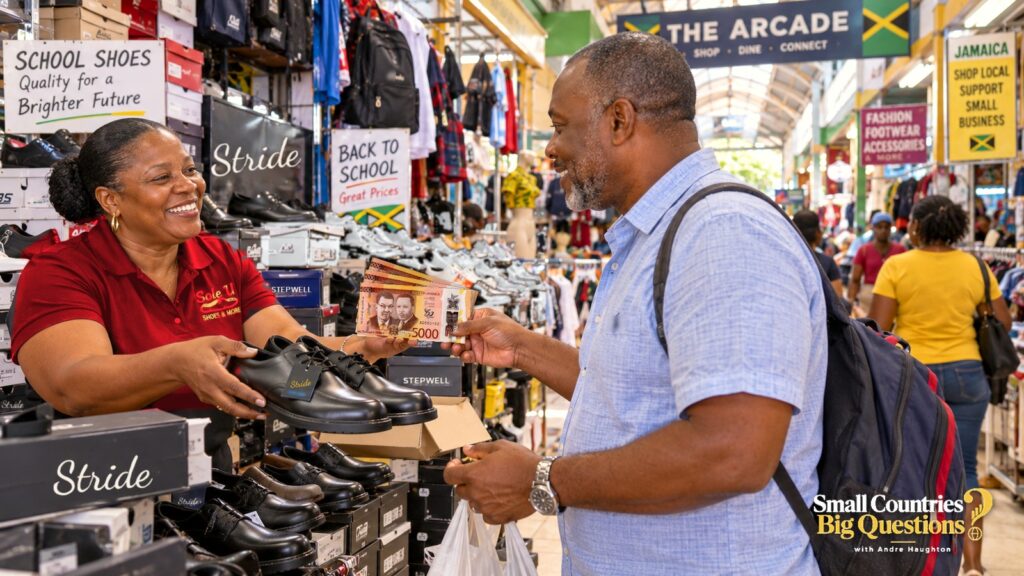
94 per cent of the Jamaicans we surveyed already pay digitally, yet only 2 of 455 use JAM-DEX as their main way to pay. Jamaicans are comfortable with a card. They are not yet sure about a digital currency in a phone wallet.
When JAM-DEX became legal tender in 2022, the first 100,000 people to sign up received J$2,500 in their wallets. The incentive brought sign-ups. Everyday use has not followed.
The findings come from our June 2023 survey and a chapter of my upcoming book, Cash, Control and Connectivity.
How do Jamaicans pay?
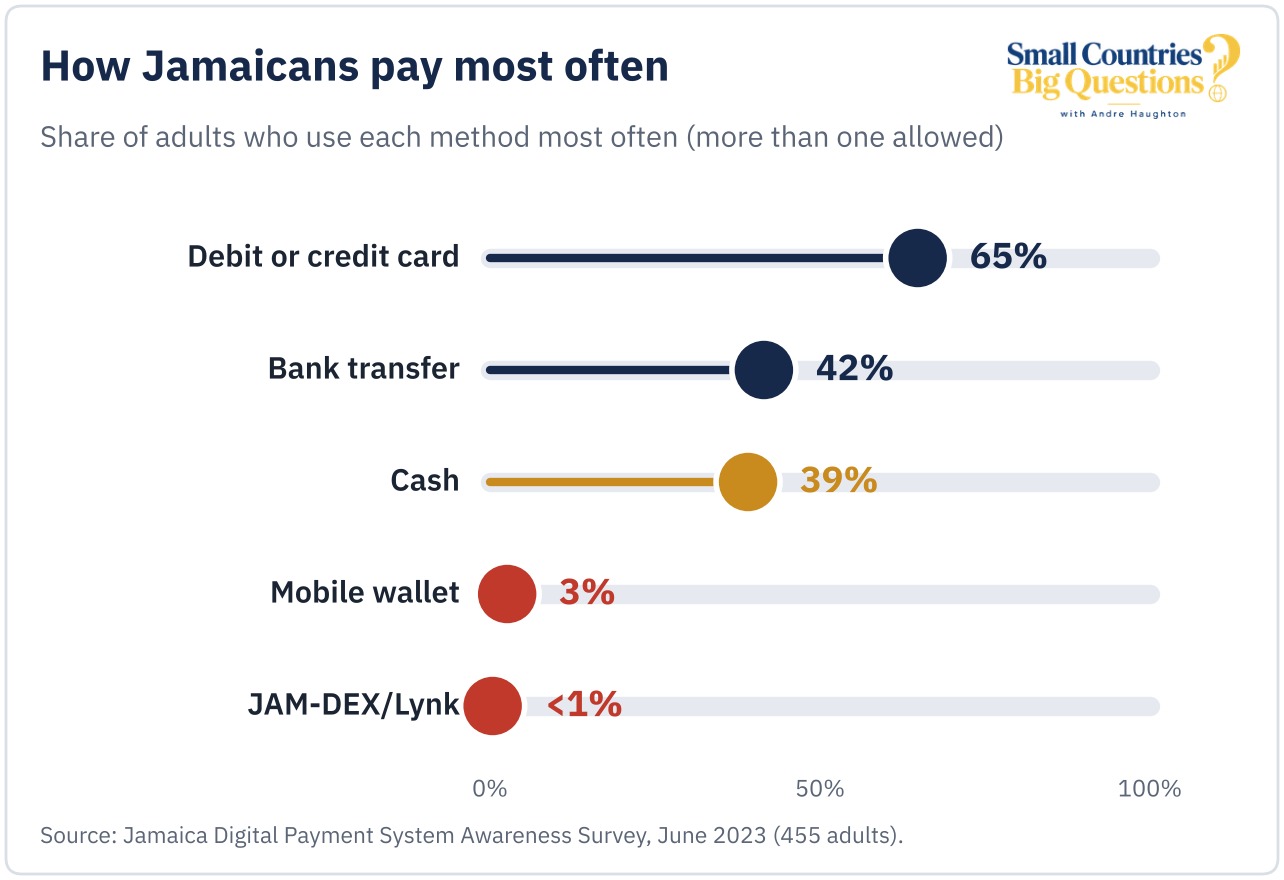
Cards lead: about two in three adults use a debit or credit card most often. Bank transfers and cash follow at about four in ten each. Mobile wallets barely register.
JAM-DEX is held and spent inside the Lynk app. Only one in five people find it easy to use, against almost everyone for cash and cards, and four in five of those who rated it have never used it. If money is hard to put on and hard to take off, people try it once and go back to what they know.
The wallets have also worked against each other. For more than a decade, banks, credit unions and remittance companies each launched their own, for their own customers. To pay by phone, a Jamaican first had to find out which wallet the other person used, and often it was none.
Have Jamaicans changed how they pay before?
Yes. In 2010 the central bank’s clearing house processed 8.9 million cheques. By 2025 the number had fallen to 2.4 million, a drop of nearly three-quarters, and most of that fall came before any policy required it. Businesses moved to electronic transfers because they were faster, cheaper and backed by banks they trusted. People switch when the new method solves a real problem through an institution they trust.
Why do people hold back?
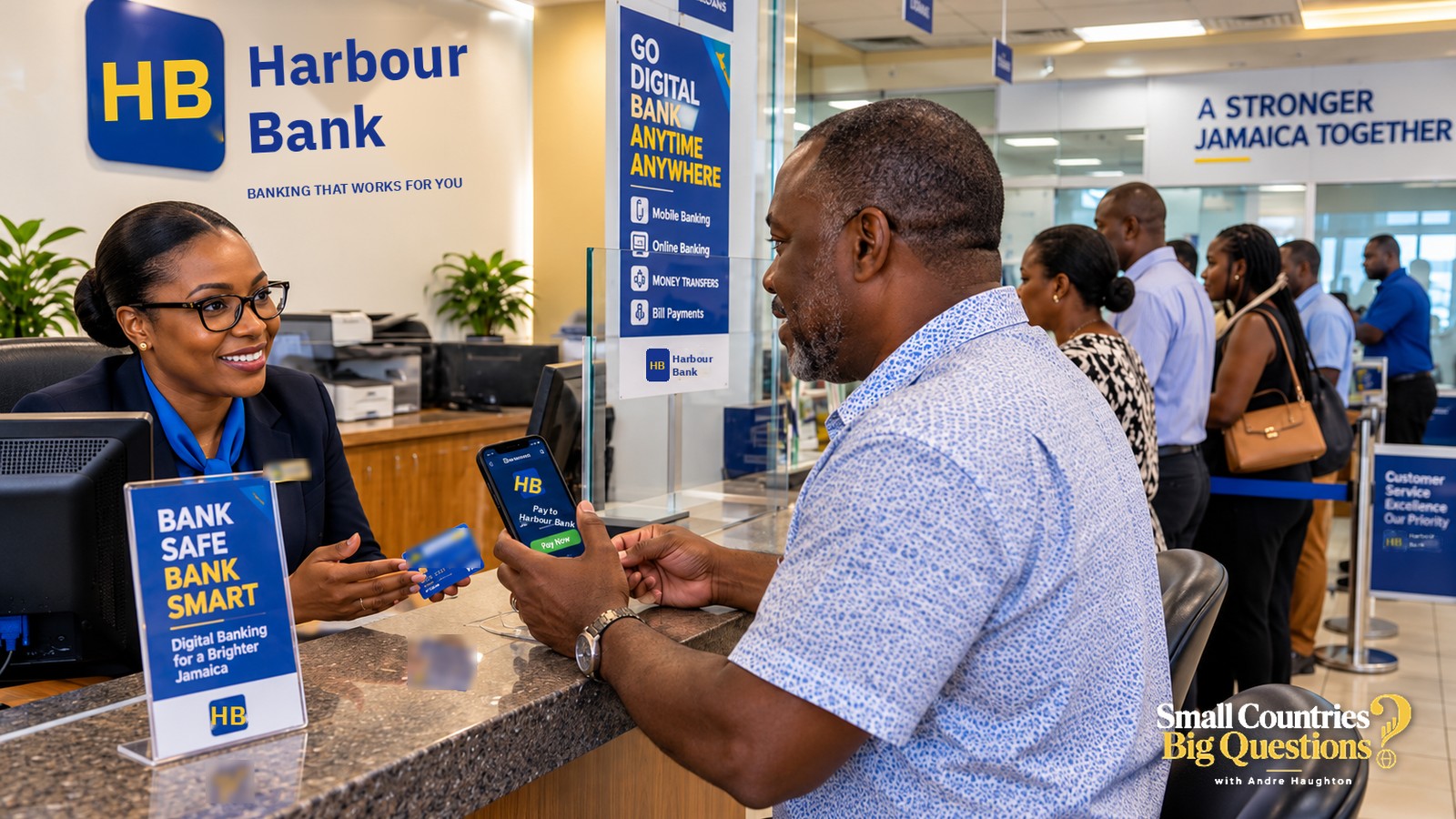
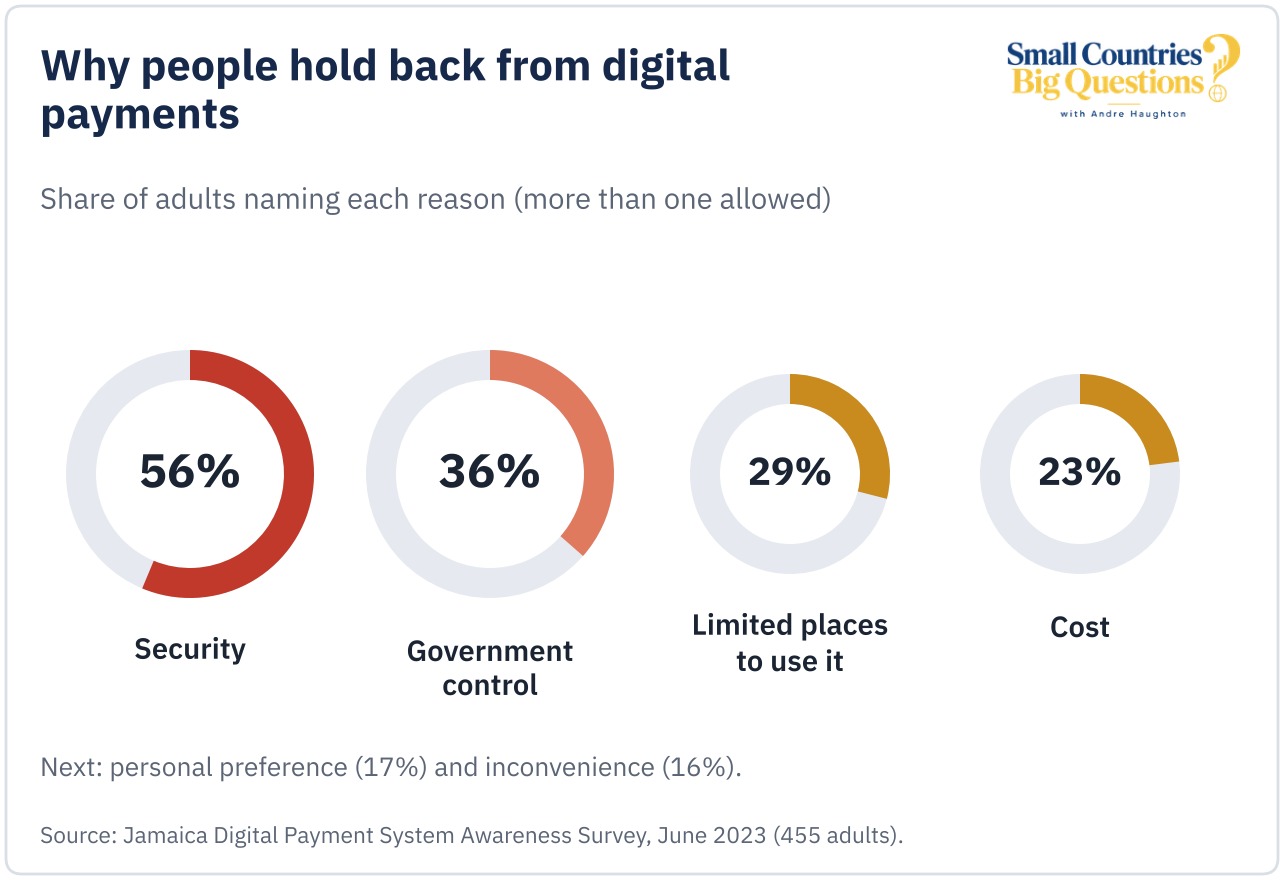
More than half named security as a reason to avoid digital payments; about a third named government control of their money. One respondent from St Andrew, aged 55 to 64, wrote that it “feels like I am being controlled.”
To see which worries actually change behavior, I used a statistical model comparing people alike in age, gender, job, parish and spending.
What drives digital payment use?
Trust. The model asks whether a person pays digitally with confidence: comfortable doing it, and spending over J$25,000 a month that way. Two results stand out, both statistically significant.
Each step up in how safe people feel digital payments are, on a scale of 1 to 5, makes them 11.5 percentage points more likely to pay digitally with confidence. Worry about the government controlling their money makes them 12.8 percentage points less likely to pay digitally with confidence.
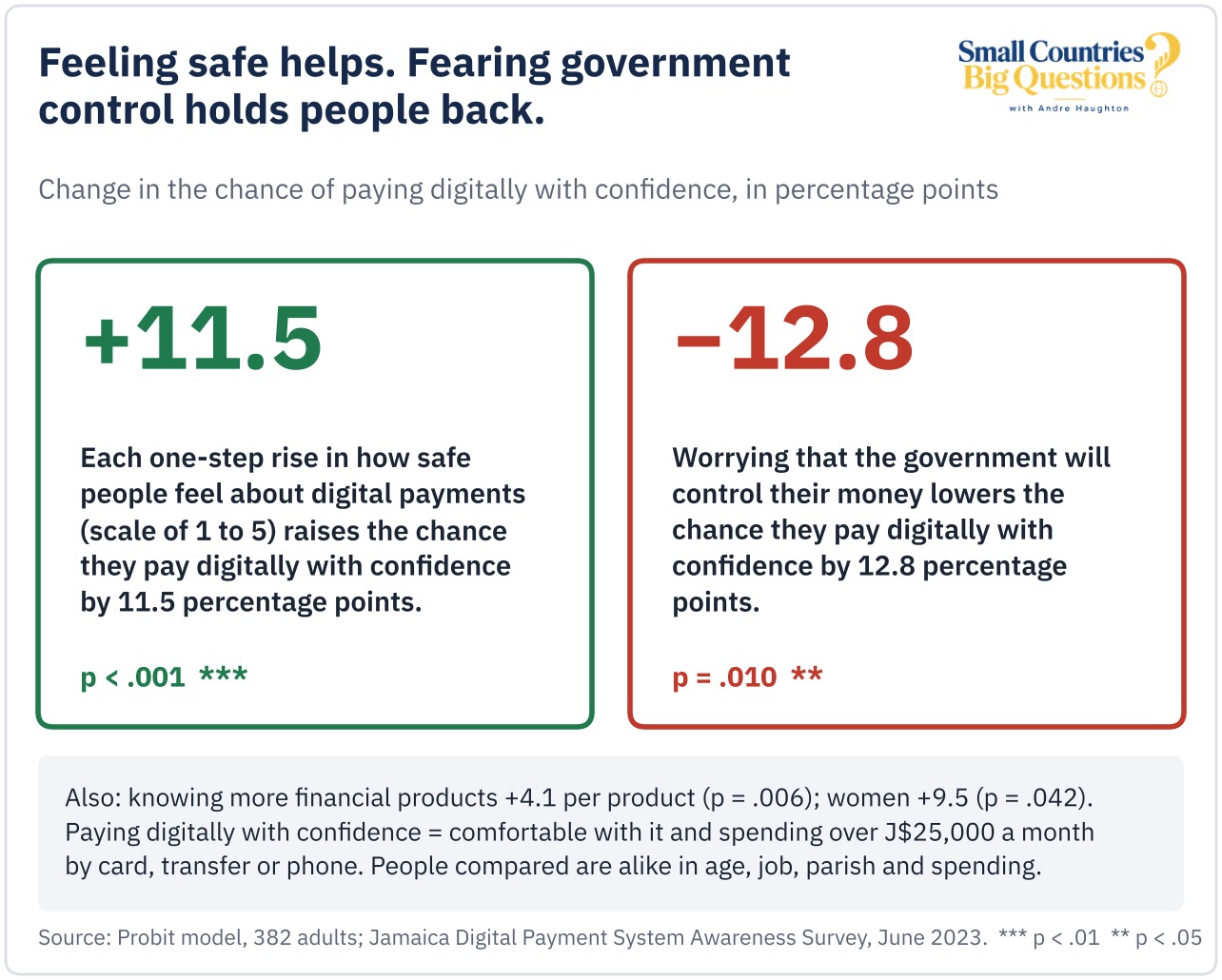
The two worries work differently. Once we know how safe a person feels, listing security as a concern adds nothing. The fear of government control remains even among those who feel safe. It is about the state, and better apps alone will not remove it.
Knowing more financial products adds about 4 points per product; employment, parish and cost made no real difference.
Who uses mobile money?
Mobile money is a young person’s product. Adults aged 18 to 24 use mobile wallets and JAM-DEX far more than those aged 35 to 64, and worry about government control makes no difference to who uses it.
What can Jamaica learn from the rest of the world?
Globally, the share of adults with an account at a bank or mobile money provider rose from 51 per cent in 2011 to 76 per cent in 2021, the World Bank reports.
Kenya’s M-Pesa, launched by Safaricom in 2007, never asked Kenyans to give up cash; it made turning cash into digital money, and back, easy at the corner shop. Sweden’s six largest banks built one wallet together, Swish, which had almost 9 million users by the end of 2024. India’s UPI connects banks and payment apps through one shared system. Each was built once, for everyone.
No Caribbean country has yet reached mass use of digital payments. Barbados, with its new BiMPay platform, is betting on connecting the banks rather than issuing a new currency.
What will build trust in digital money?
Here are four suggestions that could help.
First, systems that work every time, and one place to dispute a charge, with a deadline for resolving it.
Second, one national system that connects all banks and wallets, so that any phone can pay any shop.
Third, clear limits in law on what the state can see about people’s payments.
Fourth, easy ways to put money on a wallet and take it off at the shops and counters people already use, with help for older customers.
The Jamaican economy has to evolve, and the way we pay is part of that. Will Jamaicans still choose cash ten years from now? That depends on whether the systems, and the state, earn their trust.
Join us on Thursday, from 6 to 8 pm, for the full findings, including mobile money use by age. All are welcome.
What would make you trust digital money more? Tell me in the comments.
Andre Haughton is a Professor of Economics at the University of the West Indies (UWI), Mona, specializing in international finance, global political economy, the structural challenges facing developing economies, and development in small states. He is the author of Overcoming Productivity Challenges in Small Countries: Lessons from Jamaica and Developing Sustainable Balance of Payments in Small Countries: Lessons from Jamaica. He has been recognized as the University of the West Indies’ Most Outstanding Researcher (2017) and for the Most Outstanding Research Project (2024), was named UWI Alumnus of the Decade (1999–2009), and is an IMF Distinguished Academic Fellow. Beyond academia, he is engaged in entrepreneurship, youth development initiatives, and strategic economic thinking aimed at advancing Jamaica’s development trajectory.
Join the discussion
Tell me what you think. Comments are moderated, so keep it respectful.