
The Government collected $22.6 billion less in taxes than it planned between April and September 2026. The Independent Fiscal Commission (IFC) reported the shortfall on the 13th of November, in its review of the Government’s request to keep the fiscal rules suspended for another year. The Government collects taxes on the wages people earn, the profits businesses make and the goods people buy, whether they are made here or imported. When the economy produces less, there is less income, profit and spending to tax, and the Government collects less.
How big is the shortfall?
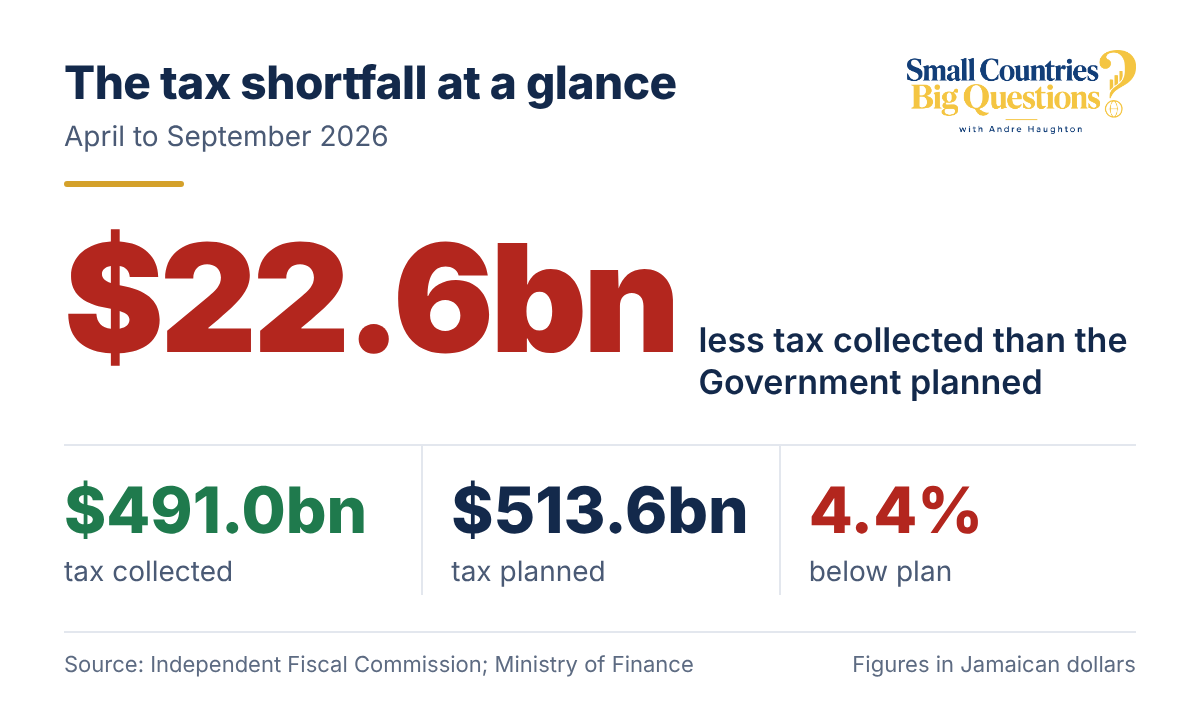
The Ministry of Finance planned to collect about $513.6 billion in taxes in the first six months of the fiscal year. It collected $491.0 billion, 4.4 per cent less than planned. When fees, grants and other income are added, total revenue came in $27.8 billion below budget.
The $22.6 billion is about three quarters of the $30 billion set aside in this year’s budget for the National Reconstruction and Resilience Authority (NaRRA) to rebuild after Hurricane Melissa.
Which taxes fell short?
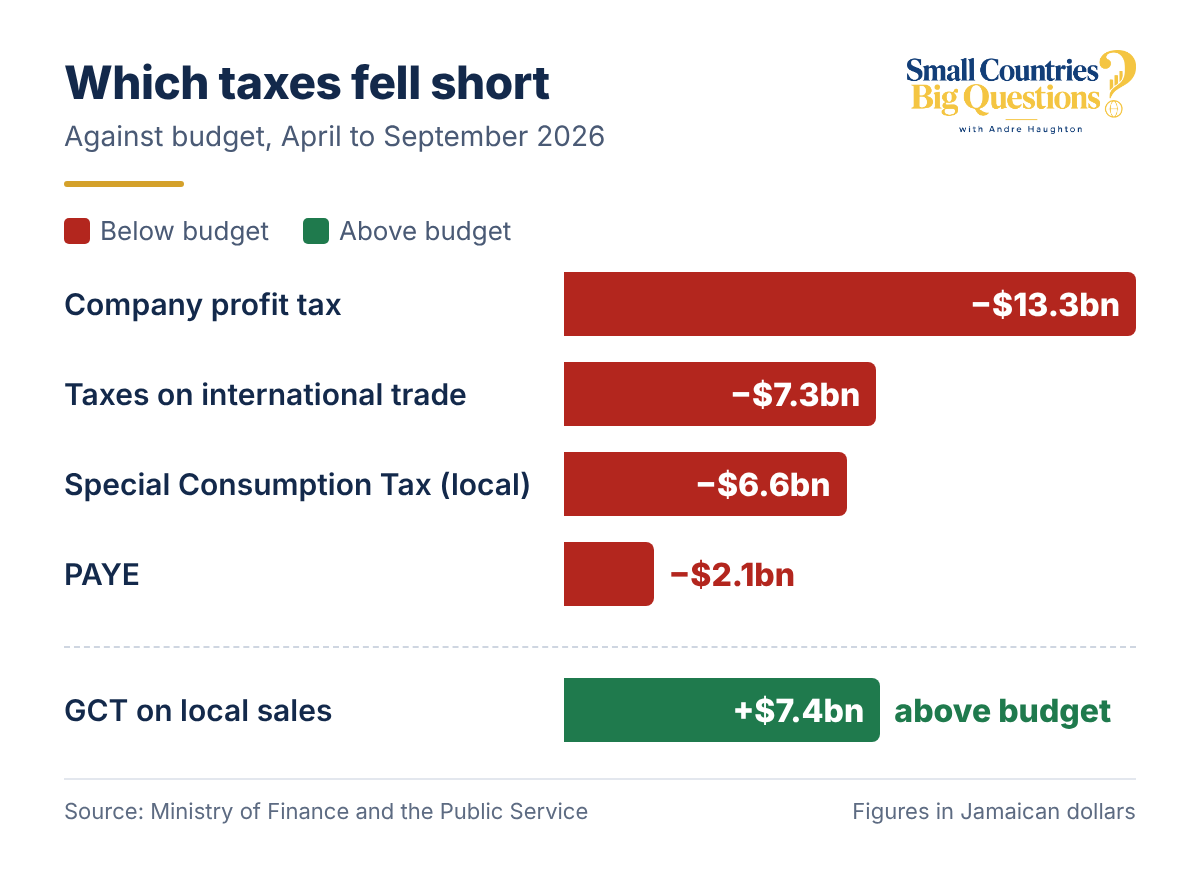
Most of the gap is in the tax companies pay on their profits. Companies paid $62.7 billion in tax on their profits, $13.3 billion less than expected. The IFC notes that part of this is timing, because some companies paid earlier than expected and their money was counted in the last fiscal year. Weaker company profits may also explain part of the gap.
The Special Consumption Tax on goods produced in Jamaica brought in $11.7 billion of the $18.3 billion expected, 36 per cent short. Taxes on international trade, which include import duties and the travel tax, were $7.3 billion short. Fewer visitors means less tax. Between April and June, the travel tax came in 33 per cent below budget and the accommodation tax on hotel rooms 22 per cent below, according to the IFC.
PAYE, the income tax taken from workers’ pay, was $2.1 billion short of an $84.2 billion target, about 2.5 per cent. GCT on local sales came in $7.4 billion above budget. Most of the shortfall is in company profit tax, the Special Consumption Tax and taxes on international trade.
How can tax be up and still short?
The Government collected 12.4 per cent more in taxes than in the same six months of 2025, $491.0 billion against $436.9 billion, yet it still fell short. The budget assumed that the dollar value of what Jamaica produces would grow by 9.2 per cent this fiscal year. The Ministry has since cut that to 7.8 per cent. A good part of the increase in collections also comes from higher prices. Inflation was 8.2 per cent in October, according to STATIN, and when prices rise, the tax on each sale rises with them even if no more is sold.
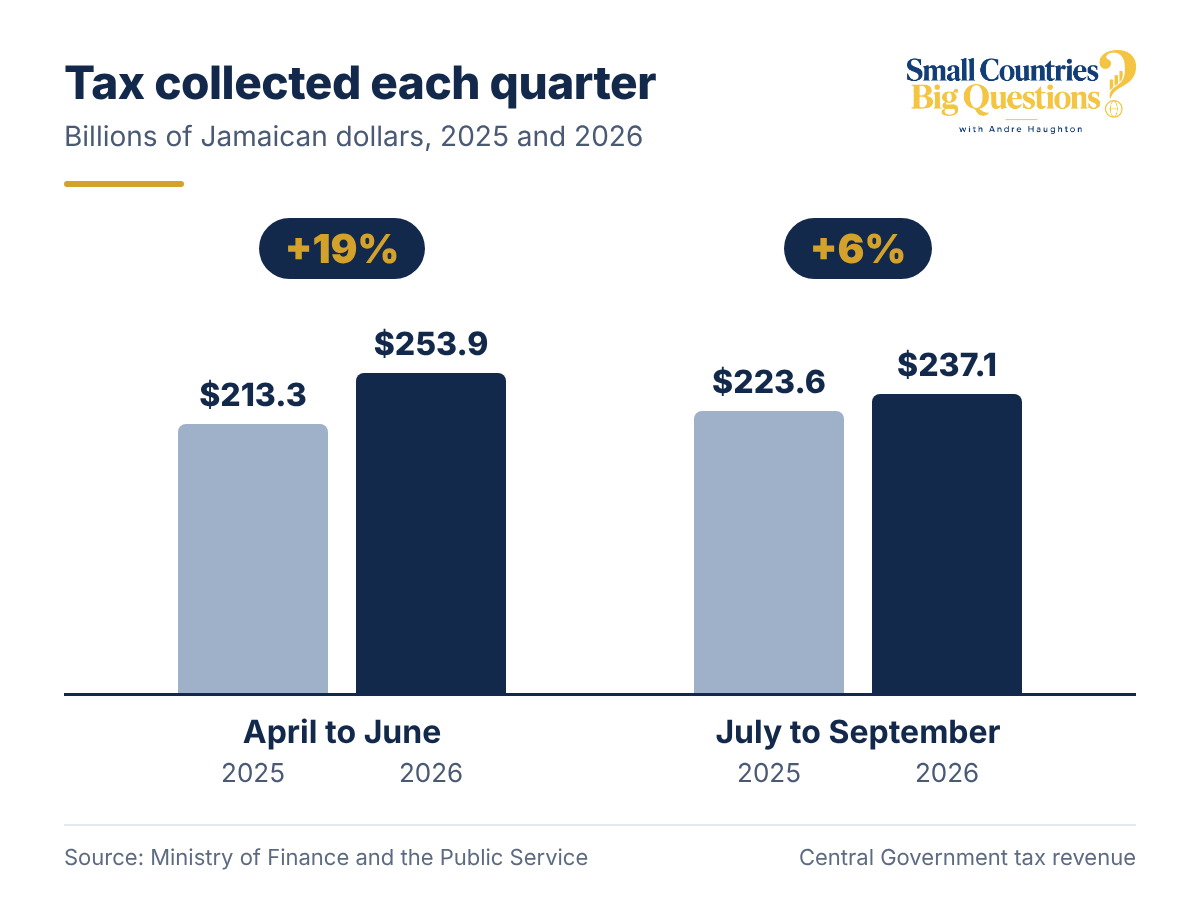
The increase is also slowing. Tax collections rose by 19 per cent between April and June and by 6 per cent between July and September.
How does lower production affect tax revenue?
Last week I set out how far output has to climb to get back to where it was before the hurricane. The tax shortfall is concentrated in the sectors that shrank the most. Between April and June, mining fell by 26.1 per cent, agriculture by 15.3 per cent and hotels and restaurants by 12.3 per cent, according to STATIN. When bauxite plants cut production, hotels have fewer guests and farms reap less, profits fall and so does the tax on those profits. The PIOJ expects output between July and September to be below last year’s level again.
What happens next?
The Ministry has cut its forecast for tax this fiscal year by only $7.8 billion, to about $971.6 billion. To reach it, the Government must collect about $481 billion between October and March, 8.6 per cent more than in the same months last year. The IFC expects revenue to stay sluggish for the rest of this year and into the next.
The Government has already adjusted its plans. The House of Representatives has approved keeping the fiscal rules suspended for another year, this year’s deficit is now projected at 5.0 per cent of GDP, and the Government plans to move the target of bringing public debt down to 60 per cent of GDP two years later, from 2029/30 to 2031/32.
There is another side to this. Some of the company tax will even out, because part of the shortfall is timing, and spending has held up. The shortfall can narrow if the economy picks up in the second half of the year.
How does Jamaica collect more tax?
Raising tax rates on a smaller economy squeezes the same businesses that need to recover. The 2026/27 budget expected taxes to equal 25.4 per cent of GDP. When businesses produce and sell more, and people earn more, the Government can collect more without raising tax rates.
The question for the rest of this fiscal year is whether the economy will grow fast enough to bring in $481 billion in six months.
Where should that growth come from? Let me know in the comments.
Andre Haughton is a Professor of Economics and Associate Dean for Partnerships in the Faculty of Social Sciences at the University of the West Indies, Mona. He is the author of Overcoming Productivity Challenges in Small Countries: Lessons from Jamaica and Developing Sustainable Balance of Payments in Small Countries: Lessons from Jamaica, and an IMF Distinguished Academic Fellow.
Sources: Independent Fiscal Commission, Validation of Extending the Suspension of the Fiscal Rules, 13th of November 2026 · Independent Fiscal Commission, Statement on Fiscal Performance, April to June 2026 · Ministry of Finance and the Public Service, Central Government Operations, April to September 2026 · Ministry of Finance and the Public Service, Fiscal Policy Paper 2026/27 (As Passed) · STATIN, quarterly gross domestic product, April to June 2026 · STATIN, consumer price index, October 2026 · PIOJ, Review of Economic Performance, April to June 2026.
Reduce unnecessary food imports, impose higher import duties on motor cars with 3000cc+ .
Thank you, Basil. Cutting the food imports we can produce here would save foreign exchange and support our farmers. Higher duties on large-engine cars would raise revenue from those most able to pay, although they would also push up the price for everyone who buys those cars. Both are options the Government can weigh against borrowing or cutting spending.
Andre,
Your article points up to the FX and monetary challenges in the next 6 – 12 months.
I read from The Gleaner that “overall fiscal deficit is projected at approximately J$196 billion, or 5% of GDP, with interest payments approaching J$200 billion.” The small primary surplus covers the intertest payments. That’s the good news; no default. But after repaying interest, the fiscal balance is still in deficit, so the government must issue new debt (mostly foreign loans) and draw down money already set aside for emergency. The funds coming from outside can expand the domestic money supply as the government spends Jamaican dollars, not USD, Yen, whatever, and this increases bank deposits. Since Jamaica follows inflation targeting, my guess is the Bank of Jamaica (BoJ) swiftly neutralises that extra liquidity by issuing its own short-term securities.
Per BoJ, its inflation target is 4.0% to 6.0%, while Jamaica’s current annual headline inflation rate stands at 8.2% (as of October 2026). Which suggests that monetary and fiscal policies are pulling in opposite directions: tight monetary policy to achieve the target, whilst fiscal policy must be “loose” to aid the recovery. However, continued slow pace means also continued large overall budget deficits. All of this is to say that the BoJ faces a stiff challenge: prevent the Jamaican dollar from falling (which would make inflation targeting more difficult), but at the same time, prevent overvaluation by buying up excess USD.
And if tourism and merchandise exports don’t do well due to an overvalued Jamaican dollar, the fiscal squeeze will stay tight.
Terence
Thank you, Terence. You have set out the policy tension well. The BOJ is tightening to bring inflation back within its target while the fiscal side has to keep spending to support the recovery, and each one weakens the other unless the two are coordinated. Your point on the exchange rate is the key one for a small open economy like ours. A falling dollar feeds imported inflation, but an overvalued dollar hurts tourism and exports, which in turn holds back tax revenue. The way out of that squeeze is production. If we earn more foreign exchange from exports and services, the BOJ faces less pressure on the dollar and the Government has a wider base to collect taxes from.
Andre,
Increasing production is clearly the best solution. But I’ wondering whether some initiatives can be done on the demand side. The other day, I was listening to a Arthur Lewis lecture by Andrew Downes on inflation and the cost of living and he said something that made sense: the cost of living is partly behavioural. I got from his speech, Caribbean people seemed hooked on North American tastes, so all over the region you see PriceSmart stores, all carrying mostly imported stuff. So: just as how the government promoted aggressive inflation targeting with music and so on to get people to “change behaviour” (inflation expectations), so too it can start a campaign to promote buy “local”. Does Jamaica need to import turkey and ham, when it has chicken and goat? That initiative, backed by government resources and tax incentives and disincentives, goes well with increasing local production and creating employment
Thank you, Terence. Downes makes a good point. Tastes shape what we import, and a buy-local campaign can shift demand the same way the Bank of Jamaica’s campaigns helped anchor inflation expectations. It works best when local producers can supply consistent quality at a fair price, otherwise people go back to the imported brand. The campaign and the push to raise production have to move together. Chicken and goat over turkey and ham would be a good start this Christmas.