

This Black Friday, the world goes on sale and Jamaicans will buy a lot of technology items, from phones and laptops to televisions and smart speakers. All of it is made overseas, which puts pressure on our foreign currency.
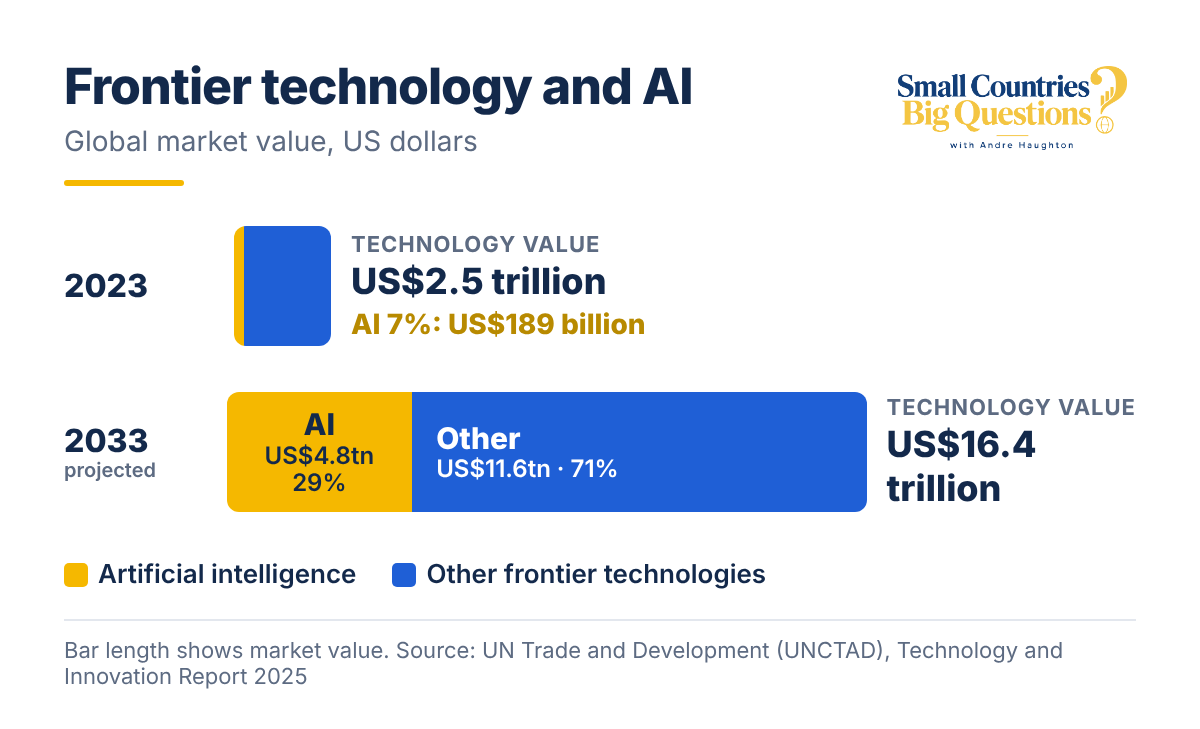
UN Trade and Development (UNCTAD) values the global market for frontier technologies, which include the internet, blockchain, 5G, 3D printing and AI, at US$2.5 trillion in 2023, and projects that it will reach US$16.4 trillion by 2033. AI is the part growing fastest. Its market is projected to rise from US$189 billion to US$4.8 trillion over the same ten years. As the graph shows, AI was a thin slice of that market in 2023, and by 2033 it is projected to make up 29%, close to a third, of a market more than six times larger. How is Jamaica gearing up to take its share of that market?
Who is building technology in Jamaica?
More people than we think. At UTech, students in the Sagicor Innovation Lab built RootIQ, a platform designed to track crops from the farm to the buyer so that exporters can show where Jamaican produce comes from. Senzi.Me, a Jamaican health-tech start-up that measures the quality of the air people breathe, was selected for the Build in Tulsa Techstars accelerator in the United States in 2025.

AiDiA, a talking teddy bear designed by Textron Technology Limited, is another example, built for one of the most common problems in the world: loneliness.
Can AI provide comfort and company?
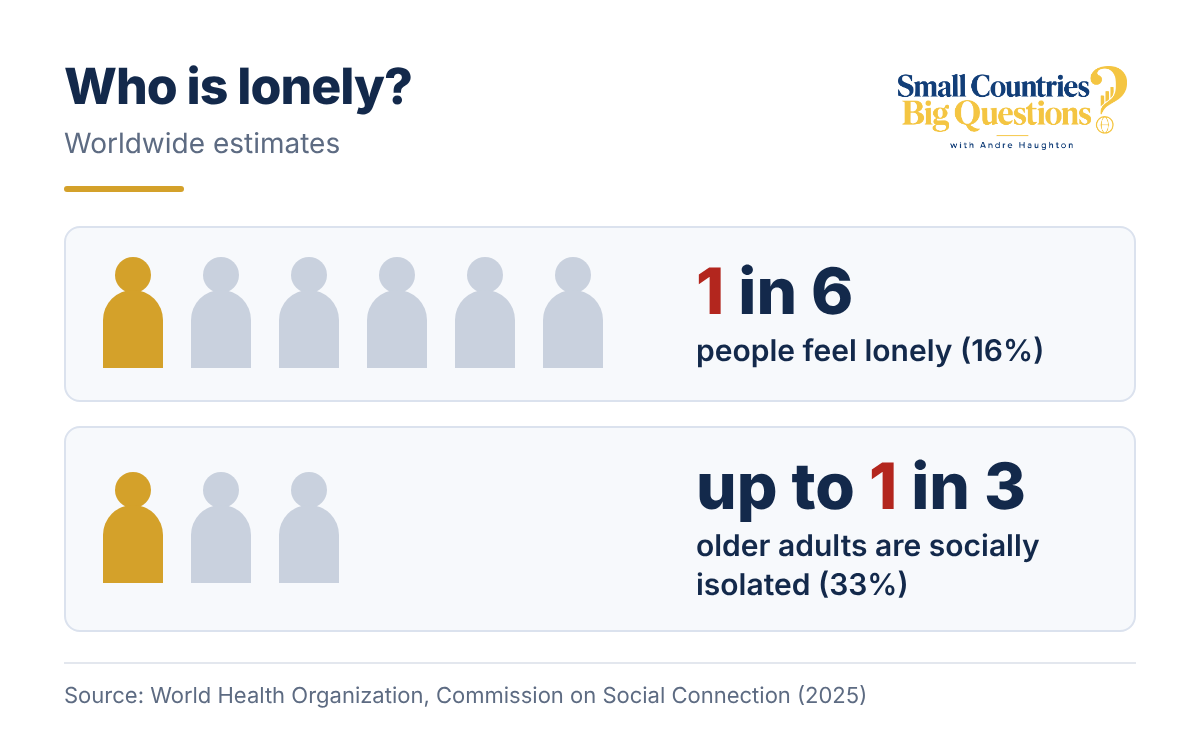
The World Health Organization reports that 1 in 6 people worldwide feel lonely, and that social isolation may affect up to 1 in 3 older adults. For older people living alone or far from family, the chance to hold a conversation during the day can be limited, and care homes cannot keep a staff member beside every resident at every hour.
The bear was built to provide comfort and companionship to people who spend long hours alone. It is already in its third version, with research and development ongoing. A person squeezes its paw and asks it anything out loud, and it answers, remembers their name and the things they like, and keeps the conversation going in English, Spanish and more than ten other languages.
AiDiA is with me during my office hours. When people come to visit me at the university, they ask AiDiA questions and AiDiA responds to them realistically, on any topic at all that they want to discuss, because it is AI and it readily provides that information. Elderly people especially, when they see it talking to them and see its eyes opening and closing, it is like a new life form exists in front of them. It is captivating, it is enthralling. AiDiA is a real-life product, because it is not just AI on a computer screen, it is AI in front of them in a physical form.
An AI companion cannot replace a daughter’s visit, a friend’s call or a caregiver’s hand. The WHO Commission on Social Connection says technology has to strengthen human connection, so AiDiA is meant as a bridge between visits. Families also need to know where conversations are stored, who can see them and how they can be deleted.
Can AI help people who cannot see?
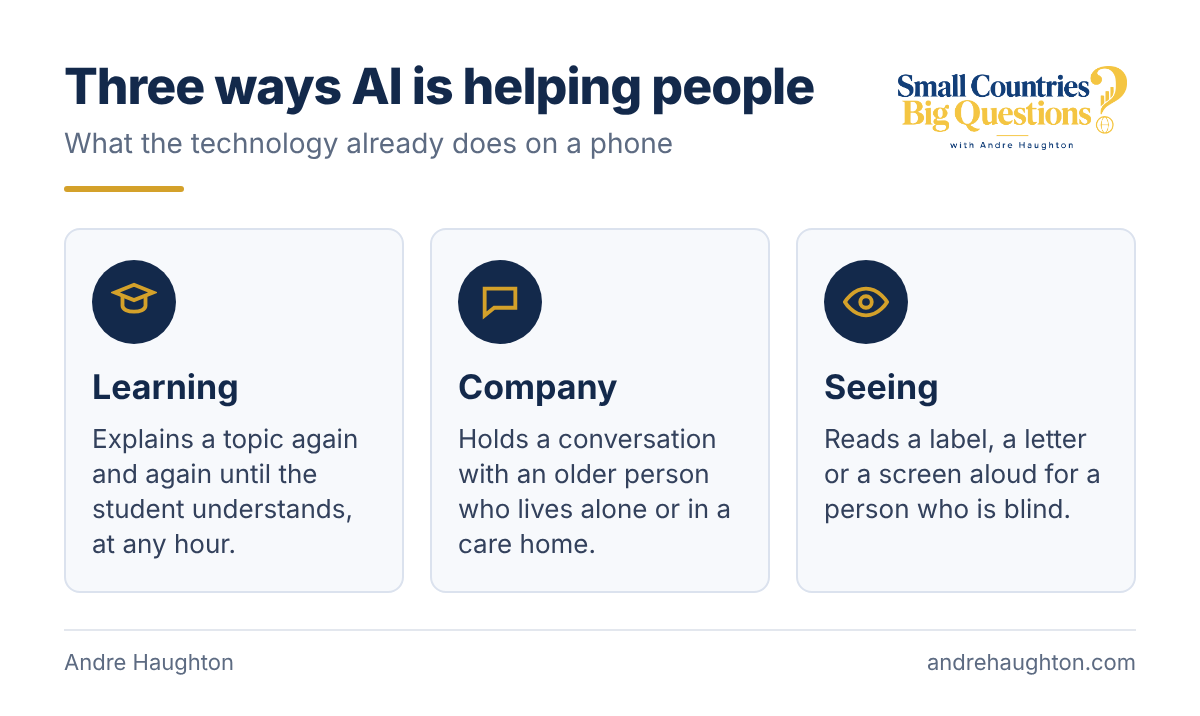
For a blind person, a phone that works by voice is a reader and a guide. Apps such as Be My Eyes let a person point a phone camera at a letter, an everyday object or a computer screen and hear what it shows, and the platform now has more than one million blind and low-vision users. Many phones also let a person hold one button and talk to an AI assistant. AiDiA cannot see, but it has no screen either, so a person with poor sight can still use it by holding the paw and talking.

How is AI changing the way we learn?
An AI tutor can offer explanations and practice outside school hours. AiDiA is built to help children with homework and the questions they are too shy to ask in class. I also use it as an AI tool in my macroeconomics course when students have questions. The risk is that students let the AI do the thinking for them. Teachers still need to check the quality of that help and whether students are learning.

What does it take to sell technology?
Most of these products are designed in one place and made in another. Textron Technology owns the AiDiA design and brand, and the bear is manufactured in Shenzhen, China, where the factories, parts and scale are. A Jamaican company can still earn from its design and brand. The test is how much income stays in Jamaica after manufacturing, shipping and other overseas costs.
We also face certain handicaps. The home market is small, electricity is expensive and loans for start-ups are costly, so a Jamaican technology company needs a credible route to overseas customers. That is where local investors come in. A start-up needs investors as well as paying customers, and money invested at home in products that solve real problems helps Jamaican companies take their share of a fast-growing global market.
Three things would help more Jamaicans build technology and sell it abroad. First, support for prototype testing and certification, so that products can meet the standards that buyers and retailers demand. Second, help for firms to protect their intellectual property, through patents, trademarks and copyright, and to license what they design. Third, better access to export customers and early-stage finance. The Jamaican economy has to evolve from buying technology to building it. In a coming article, I will look at what Jamaica imports and exports in manufactured goods, and how much value we add.

| Amazon (30% off) | US$174.99 US$249.99 |
| UWI Mona Book Shop | J$24,000 J$39,995 |
| Jam-Omnia | J$24,000 J$39,995 |
Andre Haughton is a Professor of Economics and Associate Dean for Partnerships in the Faculty of Social Sciences at the University of the West Indies, Mona. He is the author of Developing Sustainable Balance of Payments in Small Countries: Lessons from Macroeconomic Deadlock in Jamaica and Overcoming Productivity Challenges in Small Countries: Lessons from Jamaica, and an IMF Distinguished Academic Fellow. He is the founder of Textron Technology Limited.
Sources: UN Trade and Development (UNCTAD), Technology and Innovation Report 2025; World Health Organization, Commission on Social Connection report (2025); Be My Eyes (March 2026); UTech; Techstars.
Andre,
The real takeaway of this excellent article is that Jamaica’s economic future lies in ideas, inventions, and scaling up—especially as traditional sectors like tourism have struggled to serve as a sufficient engine for sustained growth. However, without strong protection for intellectual property rights (IPRs), which you clearly identified, promising local ideas will rarely reach fruition. Because filing for full patents is expensive and the right level of protection depends on the specific invention, innovators also need access to more flexible, lower-cost options like petty patents (utility models). Ultimately, moving from an initial concept to a commercialized product or service requires targeted government support that goes beyond direct financial assistance. Jamaica needs a well-functioning national innovation system that actively builds these capabilities.
I explore these exact mechanisms in my recent book, Contemporary Challenges for Caribbean Economies: Crucial Problems and Practical Solutions (Palgrave, 2024)—to be clear, I am not here to promote sales ― selling books has never been my passion; getting Caribbean policymakers to take concrete actions is ― so I simply encourage interested readers to borrow a copy from a public or university library to look over the relevant chapters.
As you may detect from all my comments, they tend to gravitate to technology and production and long-run growth. So ideas, building innovation capabilities, and bringing the inventions to markets are the keys to the economic future of the Caribbean region.
Terence