
In Jamaica today, prices are rising at least eight times faster than the return on your savings. In an attempt to contain rising prices, the Bank of Jamaica raised its policy rate to 6.0 per cent, effective September 29. Even so, the real interest rate is still below zero. Yet Jamaicans are saving more. Bank deposits rose by 12.7 per cent in 2025, according to the BOJ. The true question is whether these deposits are being channeled into productive use.
Where is the money going?
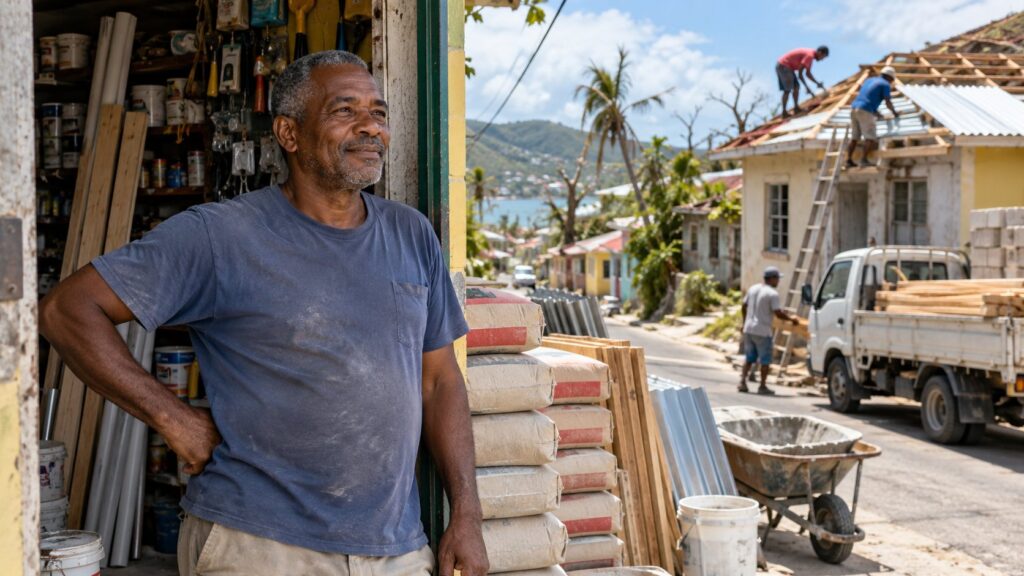
Growth in lending to businesses is about 25 per cent lower than it was last year, while lending to households grew by about 8 per cent. Much of that household borrowing pays for homes and education, but a large share goes on consumer items. In an economy where imports are equal to about half of GDP, much of that spending leaks abroad. Business borrowing is what expands production, and productive firms need financing to help the country rebuild after the hurricanes.
At the credit unions, members’ savings grew by J$8.06 billion between December 2025 and June 2026, while their loans grew by only J$2.90 billion, the slowest first-half loan growth since 2021.
The pattern is worth noting. Jamaicans are putting more money into the financial system, while lending to businesses is growing more slowly. Whether that reflects fewer applications, repayment concerns or tighter lending standards, the banks should explain it.
How will the rate increase affect this?
As inflation has risen to 7.9 per cent, the BOJ has attempted to keep prices stable. Even at 6.0 per cent, the real interest rate, which is the policy rate minus inflation, is about minus 1.9 per cent.
The US also matters. The Federal Reserve raised its rate this month by a quarter of a percentage point, and Jamaica’s increase was twice as large. When US rates rise, Jamaica faces exchange-rate and inflation risks. If Jamaican returns do not keep pace, money can move into US-dollar assets, putting pressure on the Jamaican dollar and making imports more expensive.
But a rate increase is contractionary. Borrow $100 from a Jamaican bank today, and it costs about $12 a year in interest, and a higher policy rate could push that up further. My research with Emma Iglesias, published in Economic Modelling in 2012, found that interest rate transmission in Jamaica is incomplete and asymmetric. The BOJ’s own financial stability assessment found the same pattern last year: deposit rates fell during 2025, while lending rates stayed relatively unchanged. Savers should not expect much more on their deposits, while borrowers may pay more.
Who will finance the recovery?
Recovery needs investment, and investment needs credit. The government has to step in and use other levers to help stimulate the economy.
First, make it easier for small firms to borrow against what they own. Jamaica has had a registry since 2013 that lets vehicles, equipment and stock be used as collateral, but it remains underused. Second, remove the bottlenecks slowing reconstruction, from permits to late payments to contractors, because a business waiting on a project is a riskier borrower. Third, share clearly defined lending risks through partial credit guarantees, so banks can lend to viable farms, contractors and small manufacturers.
These steps help firms produce, and firms that produce can repay. That is what makes banks willing to lend.

Jamaicans have put money into the banks. The BOJ is trying to protect what that money can buy. The next test is whether the government and the banks can put more of it to work where the country needs it most.
Have you tried to get a business loan this year? What did the bank tell you? Share your experience in the comments.
Andre Haughton is a Professor of Economics at the University of the West Indies (UWI), Mona, specializing in international finance, global political economy, the structural challenges facing developing economies, and development in small states. He is the author of Overcoming Productivity Challenges in Small Countries: Lessons from Jamaica and Developing Sustainable Balance of Payments in Small Countries: Lessons from Jamaica. He has been recognized as the University of the West Indies’ Most Outstanding Researcher (2017) and for the Most Outstanding Research Project (2024), was named UWI Alumnus of the Decade (1999–2009), and is an IMF Distinguished Academic Fellow. Beyond academia, he is engaged in entrepreneurship, youth development initiatives, and strategic economic thinking aimed at advancing Jamaica’s development trajectory.
The article is uncomplicated and easily understood.
Thank you, Basil. That is exactly the goal: economics everyone can use.
very informative
Thank you, Michael. I’m glad you found it useful.
Andre,
I like to look at commercial bank lending because it’s a leading indicator of future economic growth or recovery. So I quickly looked up Bank of Jamaica. The data confirmed my fears and yours (your recent article on the slow pace of economic recovery). Total credit growth from October 31, 2025 (when Melissa) struck to August 31, 2026 (latest) is 0.6% (compound rate), and for sectors like agriculture, mining and tourism, total advances dropped. In manufacturing, 0.6% growth. Construction loans grew 4% but the sector accounts for only 5% of total loans and advances. These are all nominal growth rates so, in constant Jamaican dollars, the banks have been shrinking their loans portfolios.
Commercial lenders are extremely risk averse. So I looked up non-performing loans and past-due loans. They have been going up, a trend that is consistent with the lending contracting. I don’t see the banks opening up their vaults unless the government provides some (temporary) guarantee for loans to agriculture, manufacturing, tourism, and so on ― industrial loans. Your suggestion about borrowers using personal assets as collateral is a sound idea. But I’m wondering if the banks prefer to make relatively safer consumer loans like car loans than more risky industrial loans.
The potential for a sharp rise in interest rates amplifies these negative lending trends and the effect on Jamaica’s debt/GDP ratio cannot be positive. That’s another story.
So: what should be done? In the short- to medium term I think Jamaica should focus “laser sharp” on the supply side and implement policies that raise output without pushing up the import bill. Agriculture and export manufacturing that use agricultural produce should be targeted. Speeding up recovery of tourism and the suppurating infrastructure is essential to generate and retain foreign exchange, even though FX leakage in this sector is quite high. I think the BoJ is doing it’s best to prevent runaway inflation that would make the Jamaican dollar uncompetitive compared to other tourism destinations (like the Dominican Republic and Costa Rica). So: it’s a huge challenge but, on a cost-benefit calculus, the emphasis should be the real side of the economy to strengthen productive capabilities.
Boosting consumer demand would yield paltry growth due to high import leakage and potentially an appreciating Jamaican dollar (assuming the BoJ attempts to restrict flexibility in the exchange rate) that would hold back recovery.
Terence
Terence, thank you again for this detailed look at the BOJ lending data. I agree with your conclusion: the emphasis should be on the real side of the economy, raising output in agriculture, export manufacturing and tourism without adding to the import bill. I responded to your data in more detail under your second comment below.
As a young business owner, I can relate to this. Access to affordable financing can be one of the biggest challenges when trying to grow and invest. Higher interest rates may help control inflation, but they also make it harder for small businesses to borrow, expand and create jobs.
I think Jamaica needs to make it easier for viable small businesses to access financing, especially by allowing equipment and other business assets to be used as collateral and expanding credit guarantee programmes. If we want economic growth and a strong recovery, more of the money being saved needs to find its way into productive businesses.
Thank you, Christopher. You have described exactly what the data shows: the savings are there, but they are not reaching businesses like yours. Making equipment and stock usable as collateral, and sharing risk through guarantees, are practical steps that could change that. I wish you every success with your business.
Professor Haughton, from an economic perspective, at what point does raising interest rates to control inflation become counterproductive by restricting business investment and slowing Jamaica’s economic recovery?
Christopher, an important question. Right now the real interest rate is still below zero (6.0% against 7.9% inflation), so policy is not yet tight in real terms. It becomes counterproductive when rates go beyond what is needed to anchor inflation expectations and start choking off viable investment. A key signal is business credit growth, which is already slowing. And because much of today’s inflation comes from supply shocks after the hurricane, higher rates can only do so much about those prices.
Andre,
I forgot to mention the phrase “pushing on a string”, economic metaphor describing how lowering interest rates may fail to stimulate a weak economy if businesses and people refuse to borrow. Higher rates would do that effectively, but behaviour is not symmetrical and are businesses going to borrow if rates held steady or dropped tomorrow; and are the commercial banks ready to lend given their weaker loan portfolios compared to pre-October 2025. Who is best positioned to revive animal spirits? That’s where government has a key role.
Terence, thank you for digging into the BOJ data. Your figures make the case even more strongly than the article did. If loan books are barely growing in nominal terms, they are shrinking in real terms, and rising non-performing loans explain why banks prefer safer consumer lending. I agree on guarantees: they share the risk banks will not carry alone. “Pushing on a string” also fits my own research, which finds that rate changes pass through unevenly. That is why government has to help revive confidence alongside the BOJ.
Good read!
Thank you, Liseann. I’m glad you found it useful.
A great article, simple put for the average Joe. Keep educating the public Andre.
Thank you, Clive. That is the aim: to make economics plain and useful for every Jamaican. I appreciate you reading and sharing your views.
Thank you for this article, Prof. As always, your explanation is clear, accessible, and logical. I certainly agree that there is considerable room for supply-side intervention, particularly as the economic disruptions caused by Hurricane Melissa continue to linger. The BOJ is constrained by its own mandate and the indirect nature of its policy instruments, while commercial lenders appear more inclined to finance consumption than productive private investment.
It is particularly concerning to see banks offering 100% motor vehicle financing and preapproved credit cards to newly employed call-centre workers, while established MSMEs may struggle to access financing for restructuring and expansion. Admittedly, these are different risk categories, but the implications for our economic recovery are significant.
Given the DBJ’s existing partial credit guarantees, perhaps the greater challenge is ensuring that these arrangements translate into genuinely affordable and accessible financing. To what extent could government strengthen these interventions through lower borrowing costs, more flexible repayment terms, and targeted restructuring support, while balancing the immediate demands of post-Melissa recovery, sustained productive investment, and the need to safeguard our hard-won fiscal and debt gains?
Thank you, Jehu. You have identified the heart of the problem: banks are financing consumption rather than production. It is striking to see 100% motor vehicle financing and preapproved credit cards flowing to new call-centre workers, while a viable MSME waiting to restructure after Melissa struggles to get a hearing. You are right that the DBJ’s partial credit guarantees are the key lever. For them to matter, the guarantee has to translate into a lower price and a longer tenor for the borrower, not just cover for the bank. Government can do more by widening the guarantee coverage for productive sectors and pairing it with the movable-collateral registry, so equipment and stock count as security. The caution, as always, is to target that support at farms, contractors and manufacturers that produce, so we protect the fiscal and debt gains we fought hard to win. Thank you for engaging so closely.
From my checks, banks do not offer loans to start businesses. Please correct me with specific information, if I’m wrong. They lend to existing businesses. A smaller financial institution launched a loan product for those wishing to start a business as a side-hustle but, it requires proof of employment etc. and collateral. I think that this novel loan product can be adopted by other financial institutions and improved upon.
Jo’Donna, you are largely right. Most bank lending goes to firms with a track record, collateral and steady cash flow, so start-ups find the door closed. That is why the article points to two fixes: make the collateral registry work so a business can borrow against equipment, stock or receivables, and share lending risk through partial credit guarantees so banks are willing to take on newer firms. The side-hustle loan you describe is a useful start, but tying it to a salary and collateral still leaves out the people who need it most. What would help most for someone starting out: a smaller loan without land as collateral, or help building a credit record first?