
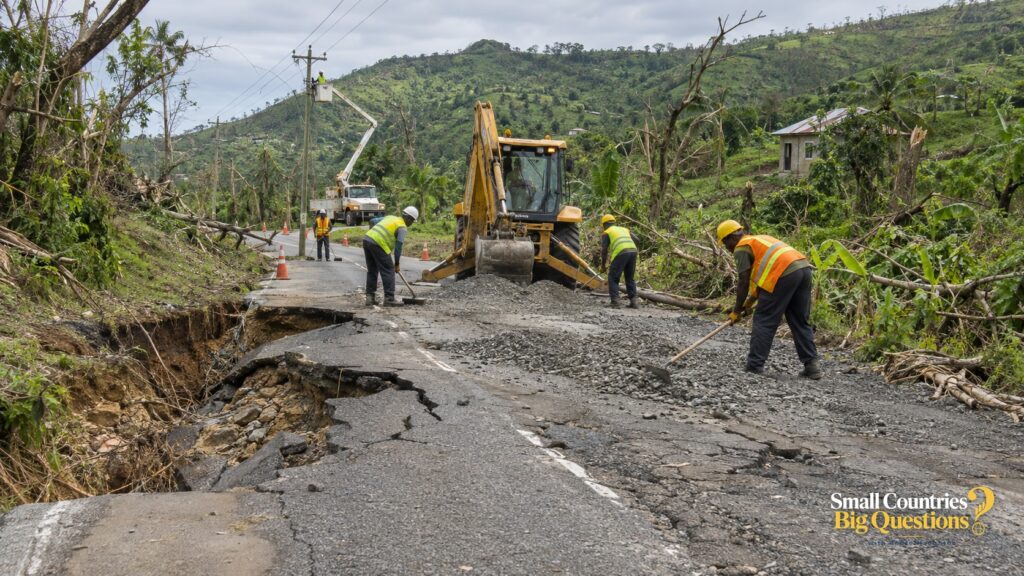
Jamaica’s economy will be back to where it was before Hurricane Melissa by the middle of 2027. That is the finding of the International Monetary Fund (IMF), which ended its annual review of the economy on the 11th of November. Getting back to where we were, however, means getting back to an economy that has grown by less than 1 per cent a year on average for the last twenty years.
What did the IMF find?
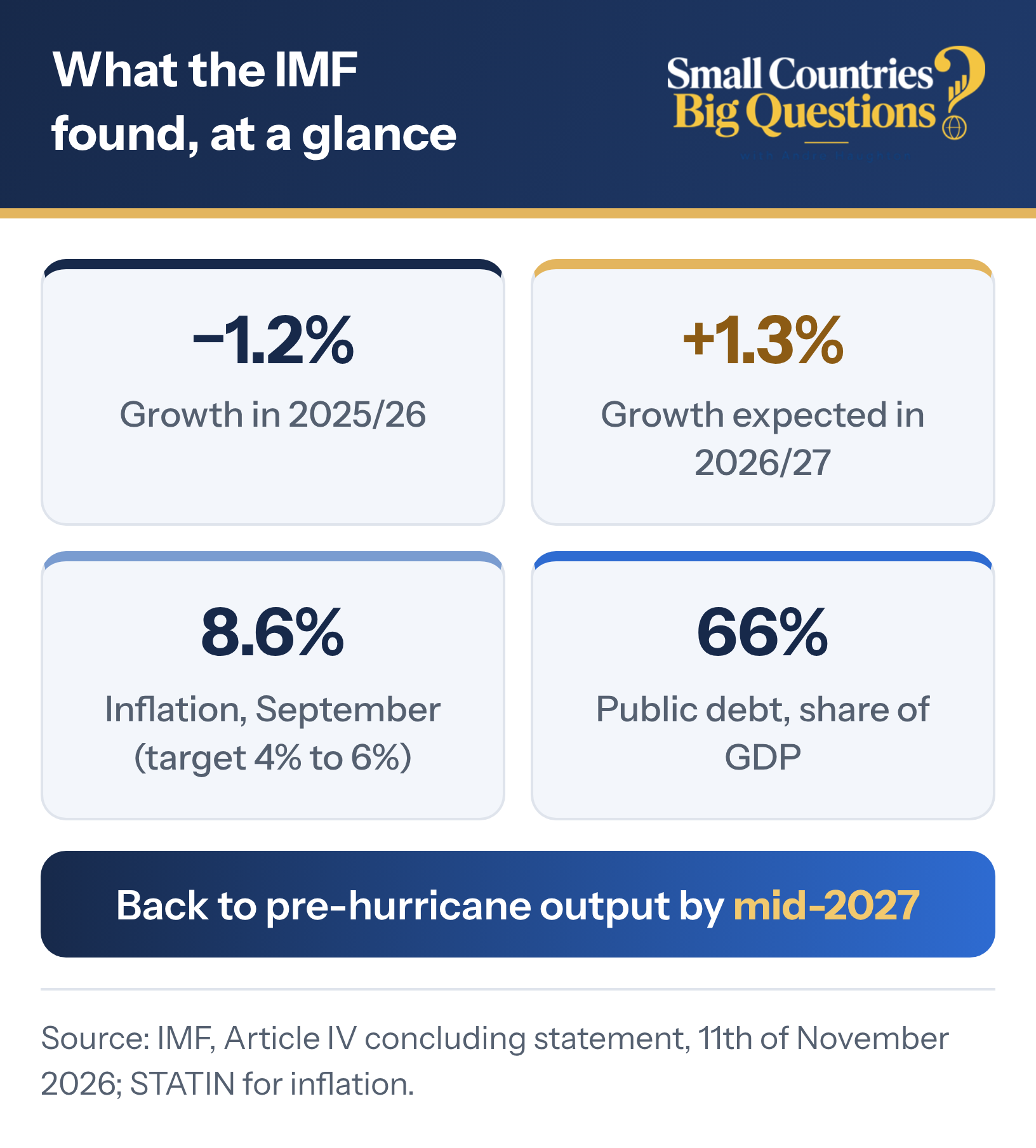
The IMF found that the economy shrank by 1.2 per cent in the 2025/26 fiscal year and expects growth of 1.3 per cent this fiscal year as reconstruction and tourism pick up. Inflation is above the Bank of Jamaica’s target of 4 to 6 per cent and should return to the target by mid-2027.
The IMF also credited Jamaica’s policy framework for carrying the country through the strongest hurricane in its recorded history. It noted that the banks remained strong and that the Government kept its access to borrowing on favorable terms.
That stability kept the country standing through the storm. It does not, however, replace the output the economy lost. The hurricane sank us so deep that we have to swim a long way just to reach back to the top of the water, much less grow.
How much do we need to claw back?
Suppose a business produced 100 units before the hurricane and the storm cut its output by 7 per cent, to 93 units. To get back to 100 units, it would need growth of 7.5 per cent, because that growth is measured from the smaller base of 93 units. The same holds for Jamaica, where the Statistical Institute of Jamaica (STATIN) reports that output fell for three quarters in a row after the hurricane.
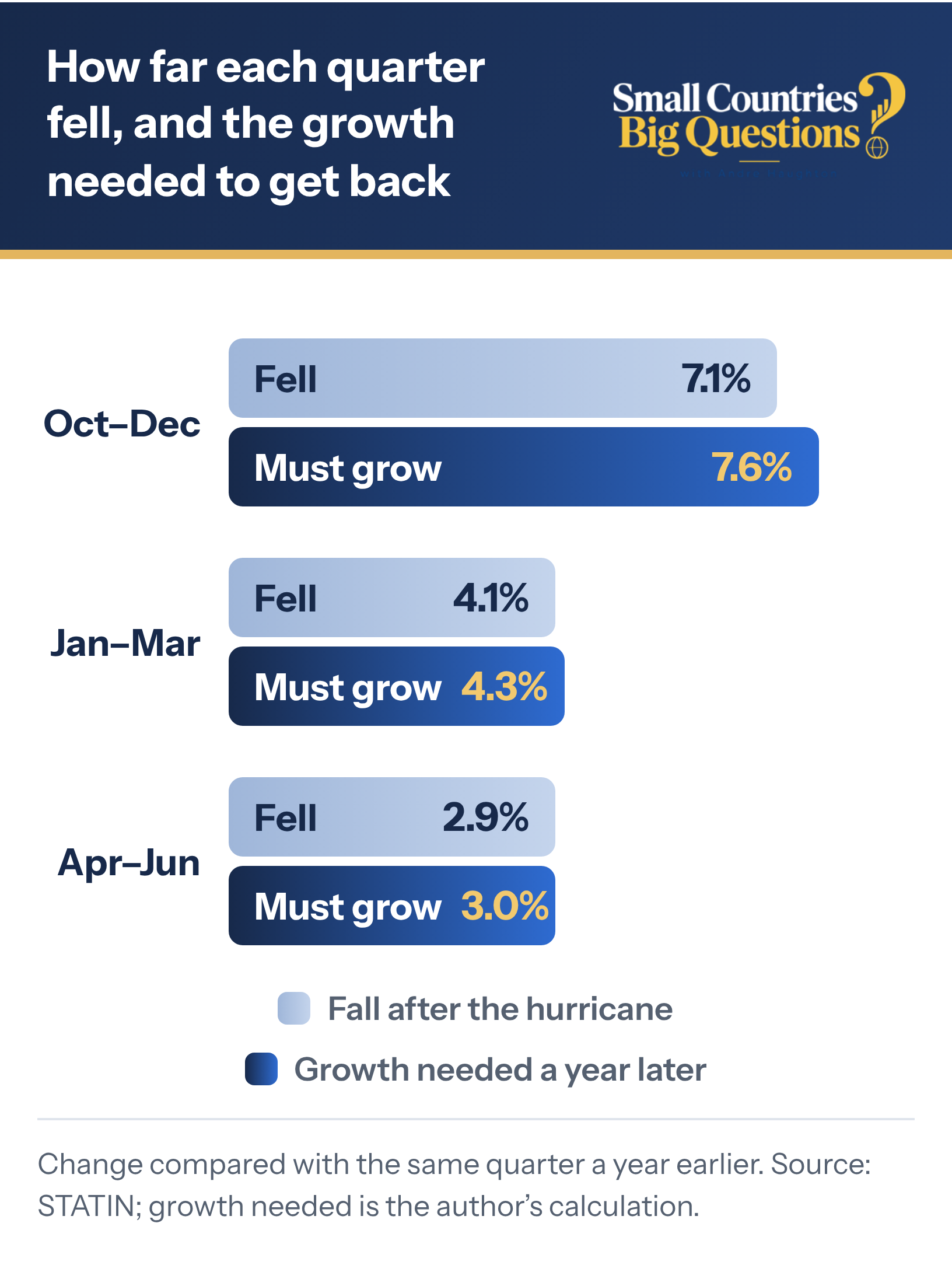
When the hurricane struck in October 2025, output for October to December fell by 7.1 per cent. So now, the October to December 2026 quarter must grow by at least 7.6 per cent for Jamaica to recover. Between January and March 2026, output fell by 4.1 per cent, so January to March 2027 has to grow by at least 4.3 per cent. Between April and June 2026, output fell by 2.9 per cent, so April to June 2027 has to grow by at least 3 per cent. The output Jamaica lost over these three quarters comes to about 3.5 per cent of what the economy produces in a year.
Do the IMF’s numbers add up?
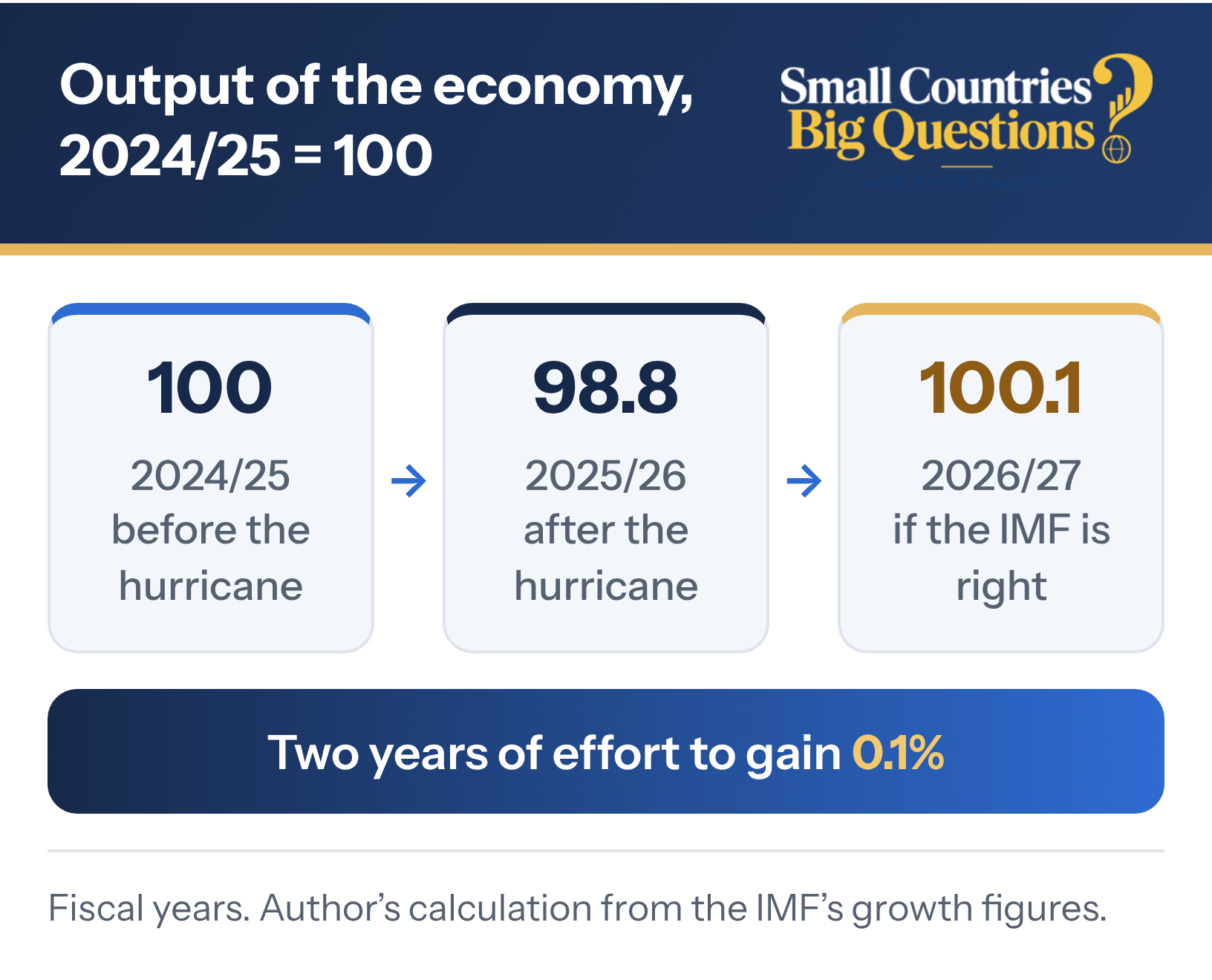
The IMF’s estimate for last year is in line with STATIN, but the projection for this year needs a closer look. If output was 100 in 2024/25, a fall of 1.2 per cent takes it to 98.8, and growth of 1.3 per cent brings it to about 100.1. Over the entire 2026/27 fiscal year, Jamaica would produce almost exactly what it produced two years earlier.
Even that requires a strong finish. April to June has already come in at minus 2.9 per cent, so the other three quarters of the fiscal year must average growth of close to 2.7 per cent, and the IMF itself says the risks are tilted to the downside.
What does twenty years of slow growth look like?
Recovery returns the economy to its old path, and the old path has been slow. According to the IMF, Jamaica’s economy grew by 18 per cent in total between 2006 and 2025, while the Dominican Republic and Costa Rica, small open economies in our region that also depend on tourism and trade, more than doubled.
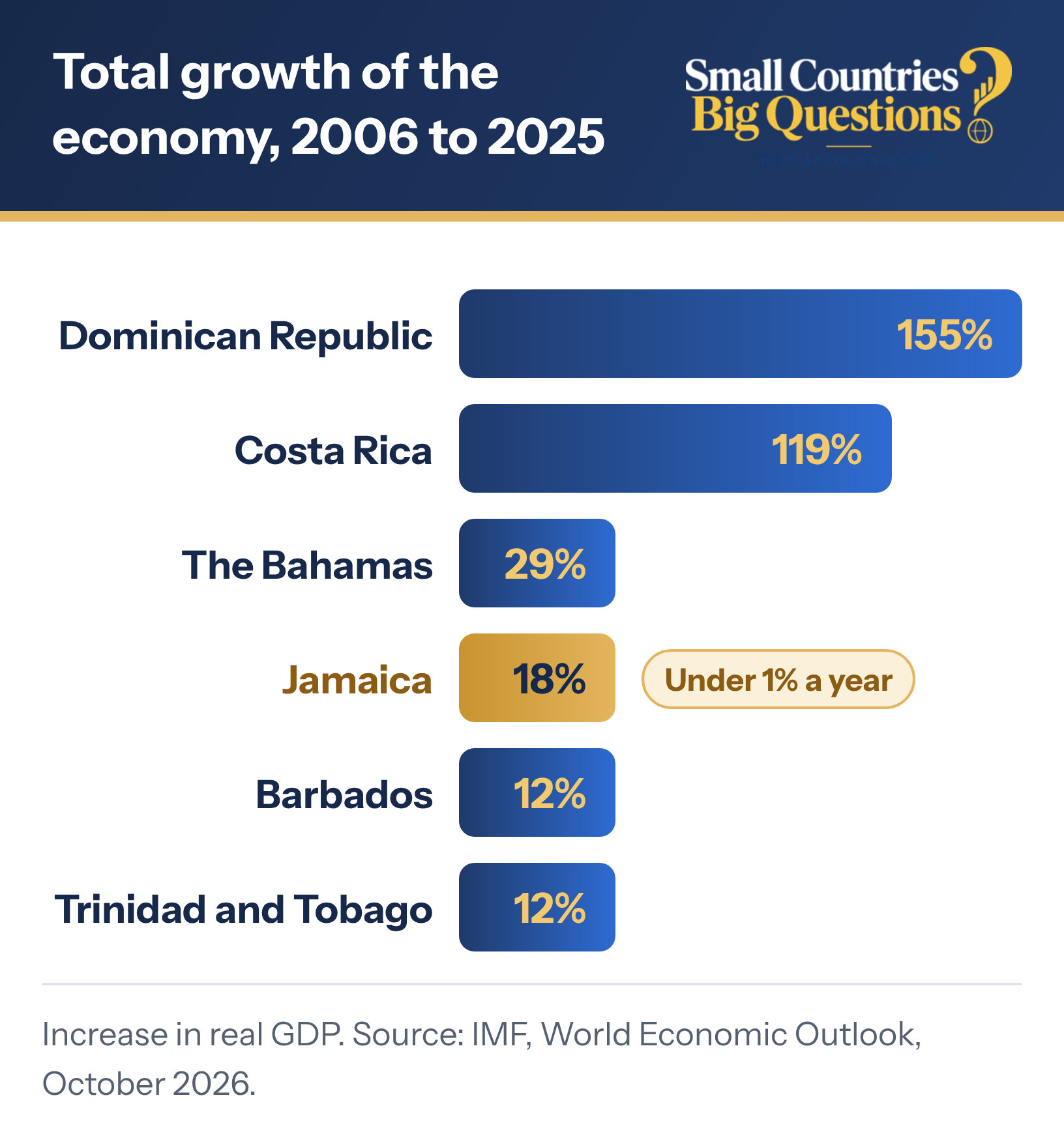
An economy that grows by less than 1 per cent a year takes about 80 years to double its income. At 5 per cent, it takes about 14 years.
What is holding Jamaica back?
The IMF points to energy, crime, regulation, skills and infrastructure, the same constraints that show up in my research on productivity. In Overcoming Productivity Challenges in Small Countries, Wendel Ivey and I found that most Jamaican industries use more labor than they need, with agriculture the exception.
Electricity is a clear example. Jamaica imports most of the fuel it uses to produce power, so every rise in world oil prices feeds into the cost of doing business and into inflation. This leaves the country susceptible to external shocks, and the IMF recommends a faster move to renewable energy.
Are fiscal and monetary policy pulling in opposite directions?
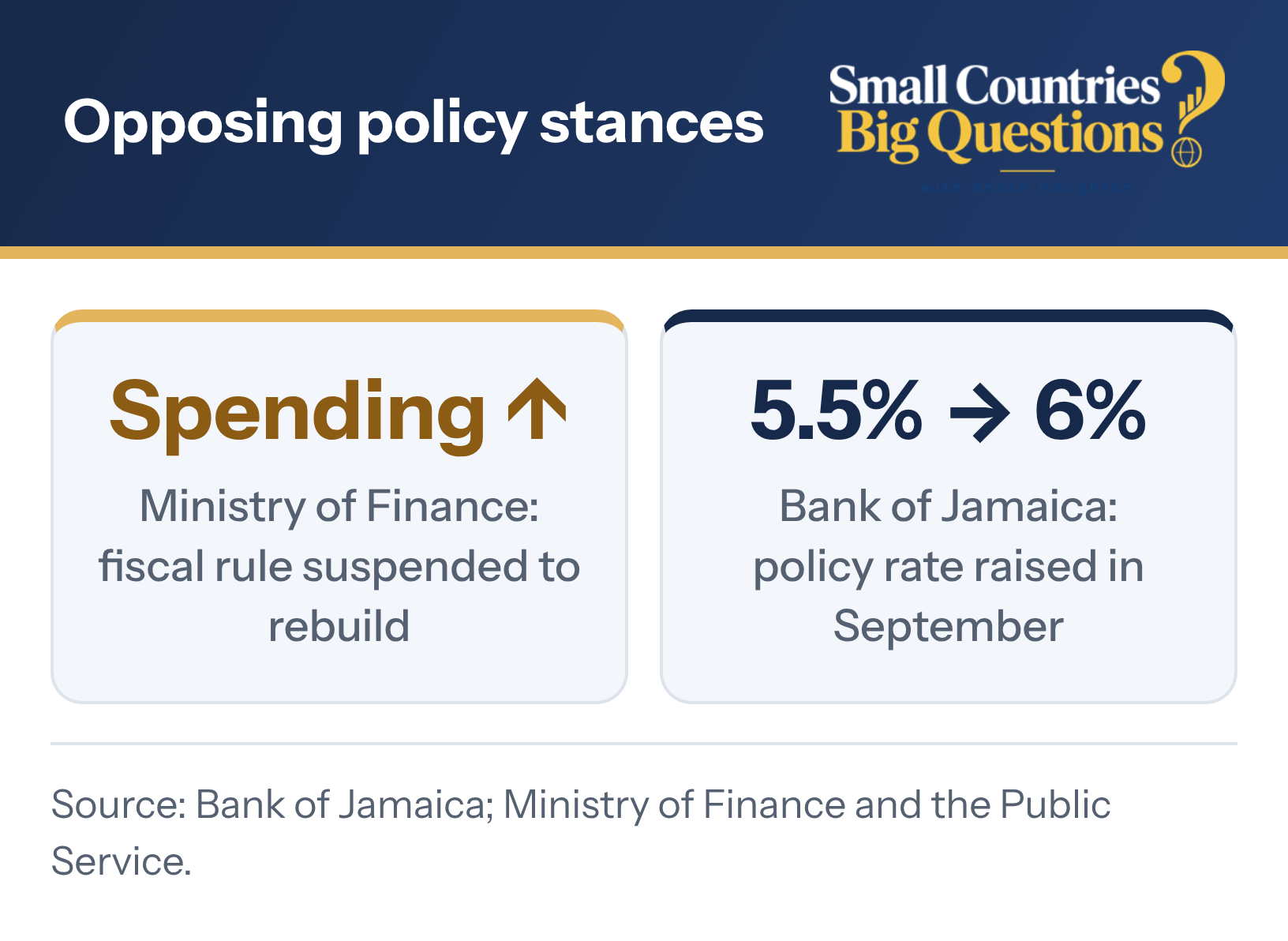
The Ministry of Finance has suspended the fiscal rule to spend on reconstruction, which is expansionary. With inflation at 8.6 per cent in September, according to STATIN, the Bank of Jamaica raised its policy rate from 5.5 to 6 per cent, which is contractionary. Both institutions are doing their jobs, but the two policies pull the economy in opposite directions.
In the Mundell–Fleming model, monetary policy is the stronger tool in a small open economy with a floating exchange rate. Jamaica operates a managed float, so fiscal policy keeps some of its strength. My research also shows that banks pass on rate increases to borrowers quickly, raising the cost of loans just when people need credit to rebuild.
What should the rebuild leave behind?
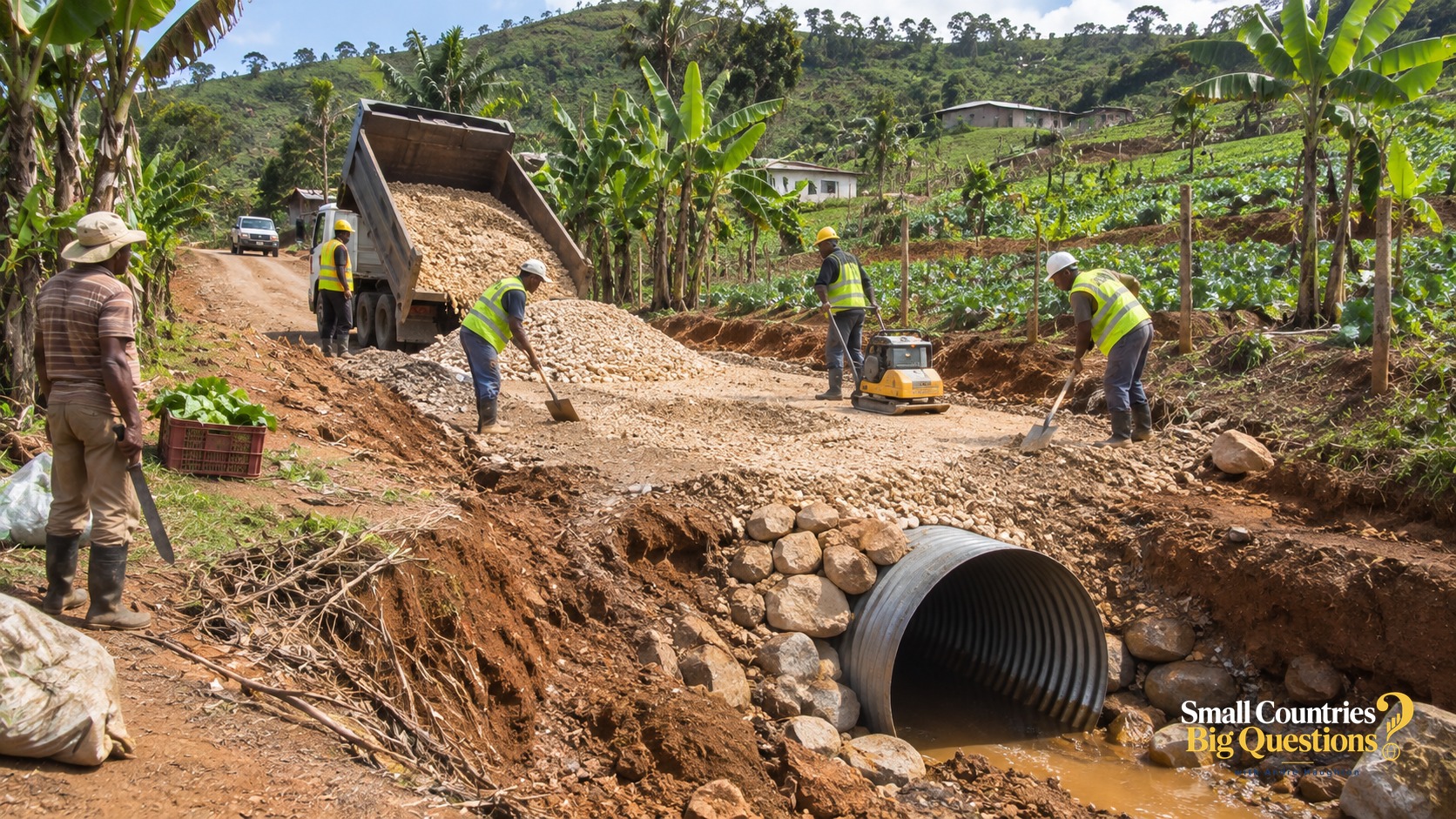
Take a farm road damaged by the storm. The test is whether the rebuilt road lets a farmer get produce to market in the rainy season, long after the contractor has been paid. The spending will lift growth for a year or two, but the lasting gain depends on what is built.
Stability is necessary but not sufficient. The next test is growth. By mid-2027 we may have recovered what the hurricane took, so what I want to know is what we will be able to produce in 2030 that we could not produce before the hurricane.
Where should we start? Let me know in the comments.
Andre Haughton is a Professor of Economics at the University of the West Indies (UWI), Mona, specializing in international finance, global political economy, the structural challenges facing developing economies, and development in small states. He is the author of Overcoming Productivity Challenges in Small Countries: Lessons from Jamaica and Developing Sustainable Balance of Payments in Small Countries: Lessons from Jamaica. He has been recognized as the University of the West Indies’ Most Outstanding Researcher (2017) and for the Most Outstanding Research Project (2024), was named UWI Alumnus of the Decade (1999–2009), and is an IMF Distinguished Academic Fellow. Beyond academia, he is engaged in entrepreneurship, youth development initiatives, and strategic economic thinking aimed at advancing Jamaica’s development trajectory.
Sources: IMF, Jamaica: Staff Concluding Statement of the 2026 Article IV Mission, 11th of November 2026 · IMF, World Economic Outlook database, October 2026 · STATIN, quarterly gross domestic product, October 2025 to June 2026 · STATIN, consumer price index, September 2026 · Bank of Jamaica, monetary policy announcement, September 2026 · Haughton, A. and Ivey, W. (2023), Overcoming Productivity Challenges in Small Countries: Lessons from Jamaica, Palgrave.
I love it. it is very informative.
Thank you, John 🙏🏾 What should Jamaica fix first to grow faster? Cast your vote in the poll and tell me why.
Jamaica can grow by producing and exporting more, supporting agriculture, manutacturing, technology and creative industries alongside tourism. That means investing in reliable roads, water, energy and training, making it easier for small businesses to get finance and reach markets, and tackling corruption with transparent spending and real accountability. We also need better paying opportunities so skilled Jamaicans can build their futures here. GDP growth must reach ordinary people through good jobs and stronger communities. Interesting times ahead!!
Thank you, David 🙏🏾 You covered it well. What would you put first: energy, finance for small businesses or training?
For Jamaica to have real growth, Jamaicans and Jamaican companies must grow. We can’t grow the economy with Chinese , Americans or any other country chunking off the Lions share of buisness activities especially those related to rebuilding after the hurricane whilst paying less than minimum wages to workers. The pillars of the economy is financed for low or no growth vis Tourism, BPO, Chinese wholesale. We must be honest and tackle the political economy and policies that favors rent seeking and wealth extraction rather than production oriented one like energy, agribusiness, and suppression of auto importation and financing of innovation of Jamaican young and old businesses. The IMF is an extractive loan shark that forms part of a regime that ensures that third world countries remains on the wine press forever. Crash the system it can’t be reformed.
Thank you, Robert. I agree that real growth has to come from Jamaicans and Jamaican firms producing more. When most of the rebuilding contracts go to foreign firms, much of the income leaves with them. Local firms should get a fair share of that work, and every worker should be paid at least the minimum wage. You are right that tourism, BPO and wholesale trade alone will not lift productivity. Energy, agribusiness and finance for young innovative businesses are where the gains are, and our policies need to reward production over rent-seeking. On the IMF, I share your concern about the conditions placed on small countries. In the 1990s we were made to liberalize before we had the buffers to cope. Where I differ is on crashing the system. A small open economy depends on access to finance and trade, and the cost of a crash falls hardest on ordinary Jamaicans. The better path is to build our own strength, through higher reserves, more exports and stronger institutions, so we negotiate from a position of power and not of need.
As the Co-founder of Plug in Jamaica Ltd., I’ve found that Jamaica’s economic recovery presents a critical opportunity to address one of the country’s most persistent structural vulnerabilities: dependence on imported oil and gas. For decades, Jamaica has spent billions of dollars importing fossil fuels that power our vehicles, businesses and economy. That money leaves the country, exposes consumers and businesses to international commodity-price shocks, contributes to inflationary pressure and weakens energy security. The Government of Jamaica, the IMF and private-sector investors should therefore view the transition from imported fossil fuels to domestically produced renewable energy and electric transportation not as an environmental expense, but as an economic-growth strategy. Every solar panel, battery-storage system, electric vehicle, charging station and renewable-energy project represents an opportunity to redirect economic activity toward Jamaica—creating jobs, developing technical skills, attracting investment and reducing the country’s exposure to volatile global oil and gas markets.
Plug In Jamaica Ltd. believes Jamaica should make transportation electrification a central pillar of this economic transformation. Government fleets, JUTC buses, taxis, school buses, tourism transportation, delivery fleets and private vehicles represent enormous opportunities to reduce petroleum consumption and retain foreign exchange within the Jamaican economy. But electrification must be paired with a rapid expansion of renewable generation, battery energy storage, and strategically located charging infrastructure. Jamaica should establish a national framework that encourages investment in solar + BESS + EV charging, including distributed charging hubs, fleet-depot charging and resilient off-grid charging systems. This would create an entirely new domestic industry encompassing renewable-energy development, electrical installation, EV sales and servicing, battery systems, software, charging networks, financing, fleet management and technical training. Plug In Jamaica Ltd. is prepared to help advance this ecosystem through public education, EV advocacy, technology partnerships, project development, and collaboration with government and private investors.
Thank you, Howard. Every dollar spent importing fuel leaves the country, so producing our own energy would keep that money here and cut our exposure to oil price shocks.
Andre,
Those IMF Press Releases and Article IV consultation should be read like political documents, that have been suitable sanitised by the recipient governments. From the IMF’s perspective, however, they are “correct” in that Jamaica is not deviating from the Standby Agreement targets or achieving them; or not misbehaving. But the IMF’s targets are aggregate indicators that mask the realities at microeconomic levels. Those indicators make good headline political news.
Years ago when banks were lending to LDCs (I was very much a part of the sovereign loan business), we relied heavily on the IMF reports for comfort that the country was credit worthy. What a waste of time. As you know, it was wave after wave of sovereign default. Jamaica was a serial defaulter.
Real recovery happens on the production side of the economy and to gauge that, you need granular, sector by sector data.
What does a drop in the Debt/GDP ratio from 150% to 100% mean in terms of employment, real incomes, access to housing, and so on?
Terence
Terence, I agree the aggregates hide what happens on the production side. That’s why I measured the recovery quarter by quarter against STATIN’s figures instead of taking the IMF’s annual number. Sector-by-sector data on output and jobs would tell us far more. Thank you for this.
We need proper infrastructure for growth to take place. And following proper infrastructure there needs to be a greater effort to empower the people through values and attitudes, civic pride, education and skills training.
Thank you, Stacy-Ann 🙏🏾 Infrastructure and skills go hand in hand: roads and power get goods to market, and skills raise what each worker can produce.
To reiterate what previous commenters have said, investments in renewable energy infrastructure would spur economic growth. Jamaica has already taken steps in the right direction (for eg. wind farms in St. Elizabeth and various solar projects). The next step should be expansion and further innovation (like biomass/biofuels). We should follow the lead of countries like Costa Rica to lower the cost of doing business and reduce our vulnerability to oil price shocks in the long run.
Thank you, Rennessa. Costa Rica shows what a small country can do when it commits to producing its own energy. Expanding wind and solar would lower the cost of doing business and cut our exposure to oil price shocks.
The MSME sector (including informal setups) which is responsible for majority of the employment and transacts the bulk of the business by volume, should be made to have easier access to funding. Monetary policy should encourage banks to have a more trustful attitude towards business venture than just for auto and mortgage financing. When these MSME’s are made to become competitive this will ripple out in to the society with a strong foundation to tackle the other challenges that afflicts the nation.
More employment will have less idle hands to commit crime. I don’t have reference to site, however, I don’t think Jamaica is under skilled, it’s more a matter of certification. Yes, there is HEART, but more can be done to encourage tradesmen and women to become certified if greater efforts are geared towards such initiative. There are more than enough examples to reference why the country should move towards renewable energy. Disruption in supply for any reason have us subjected to external shocks, and should we “discover” oil prices are set by the international market so while it would be lesser than if we don’t have our own supply we will still be impacted by pricing. That leaves us with the ease to do business which once the businesses are provided with the funding they’ll better able to implement the latest technologies, train personnel on best practices, provide comfortable and conducive environs for customers satisfaction etc.
Building on this foundation would definitely provide GDP growth and where the monetary policy falls short fiscal policy should framework should now carry the baton through social programs.
Thank you, Shamair. Small and medium businesses employ most Jamaicans, so easier access to credit would reach a lot of people. Your point on certification matters too: many workers have the skills but not the papers to prove it.